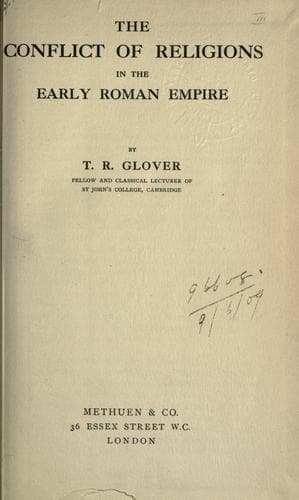
The Conflict of Religions in the Early Roman EmpireGlover, T. R. (Terrot Reaveley)
Religion
The Conflict of Religions in the Early Roman Empire
Glover, T. R. (Terrot Reaveley)
Christianity and other religions; Church history -- Primitive and early church, ca. 30-600; Rome -- Religion
Thus the fundamental conceptions of the Christians are shown to be
wrong, but more remains to be done. Let us assume for purposes of
discussion that there could be a "descent of God"--would it be what the
Christians say it was? "God is great and hard to be seen," he makes
the Christian say, "so he put his own spirit into a body like ours and
sent it down here that we might hear and learn from it."[39] If that is
true, he says, then God's son cannot be immortal, since the nature of a
spirit is not such as to be permanent; nor could Jesus have risen again
in the body, "for God would not have received back the spirit which he
gave when it was polluted with the nature of the body."[40] "If he had
wished to send down a spirit from himself, why did he need to breathe
it into the womb of a woman? He knew already how to {249} make men,
and he could have fashioned a body about this spirit too, and so
avoided putting his own spirit into such pollution."[41] Again the
body, in which the spirit was sent, ought to have had stature or beauty
or terror or persuasion, whereas they say it was little, ugly and
ignoble.[42]
Then, finally, "suppose that God, like Zeus in the Comedy, waking out
of long sleep, determined to rescue mankind from evil, why on earth did
he send this spirit (as you call it) into one particular corner? He
ought to have breathed through many bodies in the same way and sent
them all over the world. The comic poet, to make merriment in the
theatre, describes how Zeus waked up and sent Hermes to the Athenians
and Lacedaemonians; do you not think that your invention of God's son
being sent to the Jews is more laughable still?"[43] The incarnation
further carried with it stories of "God eating"--mutton, vinegar, gall.
This revolted Celsus, and he summed it all up in one horrible word.[44]
[Sidenote: The ignominy of Jesus]
Public-domain text, read in full here on John Shaqi.
Reviews
Reviews
No reviews yet
Be the first to share your thoughts on this work.
Elsewhere in the archive
Join the Discussion
Join the discussion
Sign in to leave a comment or review.
Sign InorCreate an account