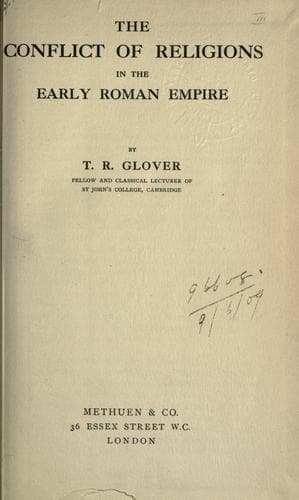
The Conflict of Religions in the Early Roman EmpireGlover, T. R. (Terrot Reaveley)
Religion
The Conflict of Religions in the Early Roman Empire
Glover, T. R. (Terrot Reaveley)
Christianity and other religions; Church history -- Primitive and early church, ca. 30-600; Rome -- Religion
If you invalidate this thought (_dogma_), probably the Emperor will
punish you. For if all men were to do as you do, nothing will prevent
the Emperor being left alone and deserted,[99] and all things on earth
falling into the power of the {257} most lawless and barbarous savages,
with the result that neither of your religion nor of the true wisdom
would there be left among men so much as the name.[100] You will
hardly allege that if the Romans were persuaded by you and forsook all
their usages as to gods and men, and called upon your 'Most High' or
whatever you like, he would descend and fight for them and they would
need no other help. For before now that same God promised (as you say)
this and much more to those who served him, and you see all the good he
has done them and you. As for them [the Jews], instead of being
masters of all the earth, they have not a clod nor a hearthstone left
them; while you--if there is any of you left in hiding, search is being
made for him to put him to death."[101] The Christian sentiment that it
is desirable for all who inhabit the Empire, Greeks and barbarians,
Asia, Europe and Libya, to agree to one law or custom, is foolish and
impracticable.[102] So Celsus calls on the Christians "to come to the
help of the Emperor with all their might and labour with him as right
requires, fight on his behalf, take the field with him, if he call on
you, and share the command of the legions with him[103]--yes, and be
magistrates, if need be, and to do this for the salvation of laws and
religion."[104]
It will be noted that, so far as our fragments serve us, Celsus
confines himself essentially to the charges of folly, perversity, and
want of national feeling. An excessive opinion of the value of the
human soul and an absurd fancy of God's interest in man are two of the
chief faults he sees in Christianity.[105] He sees well, for the love
of God our Father and the infinite significance of the meanest and
commonest and most depraved of men were after all the cardinal
doctrines of the new faith. There can be no compromise between the
Christian conception of the Ecclesia of God and Celsus' contempt for an
"ecclesia of worms in a pool"; nor between the "Abba Father" of Jesus
and the aloof and philosophic God of Celsus "away beyond everything."
These two {258} contrasts bring into clear relief the essentially new
features of Christianity, and from the standpoint of ancient philosophy
they were foolish and arbitrary fancies. That standpoint was
unquestioned by Celsus.
[Sidenote: The failure of Celsus]
Public-domain text, read in full here on John Shaqi.
Reviews
Reviews
No reviews yet
Be the first to share your thoughts on this work.
Elsewhere in the archive
Join the Discussion
Join the discussion
Sign in to leave a comment or review.
Sign InorCreate an account