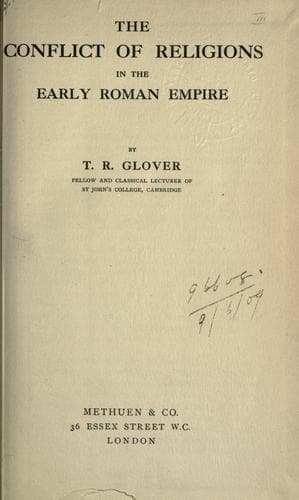
The Conflict of Religions in the Early Roman EmpireGlover, T. R. (Terrot Reaveley)
Religion
The Conflict of Religions in the Early Roman Empire
Glover, T. R. (Terrot Reaveley)
Christianity and other religions; Church history -- Primitive and early church, ca. 30-600; Rome -- Religion
Confident in the truth of his premisses and the conclusions that follow
from them, Celsus charged the Christians with folly and dogmatism. Yet
it would be difficult to maintain that they were more dogmatic than
himself; they at least had ventured on the experiment of a new life,
that was to bring ancient Philosophy to a new test. They were the
researchers in spiritual things, and he the traditionalist. As to the
charge of folly, we may at once admit a comparatively lower standard of
education among the Christians; yet Lucian's book _Alexander_, with its
curious story of the false prophet who classed them with the Epicureans
as his natural enemies, suggests that, with all their limitations, they
had an emancipation of mind not reached by all their contemporaries.
If they did not accept the conclusions of Greek thinkers as final, they
were still less prepared to accept sleight-of-hand and hysteria as the
ultimate authority in religious truth.[106] Plutarch, we may remember,
based belief in immortality on the oracles of Apollo; and Celsus
himself appeals to the evidence of shrines and miracles. If we say
that pagans and Christians alike believed in the occurrence of these
miracles and in daemonic agency as their cause, it remains that the
Christians put something much nearer the modern value upon them, while
Celsus, who denounced the Christians as fools, tendered this
contemptible evidence for the religion he advocated.
His Greek training was in some degree the cause of this. The
immeasurable vanity of the Greeks did not escape the Romans. A sense
of indebtedness to the race that has given us Homer, Euripides and
Plato leads us to treat all Greeks kindly--with more kindness than
those critics show them whose acquaintance with them has been less in
literature and more in life. The great race still had gifts for
mankind, but it was now mainly living upon its past. In Plutarch the
pride of race is genial and pleasant; in Celsus it takes another
form--that of contempt for the barbarian and the unlettered. {259} The
truism may be forgiven that contempt is no pathway to understanding or
to truth; and in this case contempt cut Celsus off from any real access
to the mind of the people he attacked. He read their books; he heard
them talk; but, for all his conscious desire to inform himself, he did
not penetrate into the heart of the movement--nor of the men. He
missed the real motive force--the power of the life and personality of
Jesus, on which depended the two cardinal doctrines which he assailed.
Public-domain text, read in full here on John Shaqi.
Reviews
Reviews
No reviews yet
Be the first to share your thoughts on this work.
Elsewhere in the archive
Join the Discussion
Join the discussion
Sign in to leave a comment or review.
Sign InorCreate an account