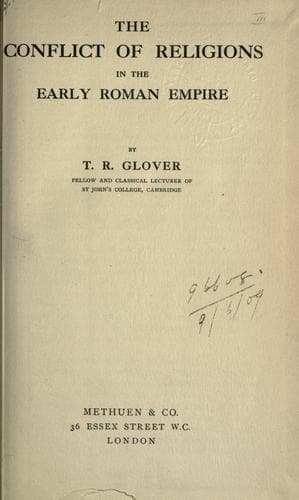
The Conflict of Religions in the Early Roman EmpireGlover, T. R. (Terrot Reaveley)
Religion
The Conflict of Religions in the Early Roman Empire
Glover, T. R. (Terrot Reaveley)
Christianity and other religions; Church history -- Primitive and early church, ca. 30-600; Rome -- Religion
The extraordinary blunders, to which the very surest critics in
literature are liable, may prepare us for anything. But to those who
have some intimate realization of the mind of Jesus, the portrait which
Celsus drew of him is an amazing caricature--the ignorant Jewish
conjuror, who garbles Plato, and makes no impression on his friends, is
hardly so much as a parody. It meant that Celsus did not understand
the central thing in the new faith. The "godhead" of Jesus was as
absurd as he said, if it was predicated of the Jesus whom he drew; and
there he let it rest. How such a dogma could have grown in such a case
he did not inquire; nor, finding it grown, did he correct his theory by
the fact. Thus upon the real strength of Christianity he had nothing
to say. This was not the way to convince opponents, and here the
action of the Christians was sounder and braver. For they accepted the
inspiration of the great men of Greece, entered into their spirit (as
far as in that day it was possible), and fairly did their best to put
themselves at a universal point of view.[107] They had the larger
sympathies.
Yet for Celsus it may be pleaded that his object was perhaps less the
reconversion of Christians to the old faith than to prevent the
perversion of pagans to the new. But here too he failed, for he did
not understand even the midway people with whom he was dealing. They
were a large class--men and women open to religious ideas from whatever
source they might come--Egypt, Judaea, or Persia, desirous of the
knowledge of {260} God and of communion with God, and in many cases
conscious of sin. In none of these feelings did Celsus share--his
interests are all intellectual and practical. Plutarch before him, and
the Neo-Platonists after him, understood the religious instincts which
they endeavoured to satisfy, and for the cold, hard outlines of Celsus'
hierarchy of heavenly and daemonic beings they substituted
personalities, approachable, warm and friendly (_ho philos Apollon_).
Men felt the need of gods who were Saviours,--of gods with whom they
might commune in sacraments--as the rise of Mithra-worship shows. They
sought for salvation from sin, for holiness--the word was much on their
lips--and for peace with God. To Celsus these seem hardly to have been
necessities; and whether we say that he made no effort to show that
they were provided for in the old religion, or that he suggested,
tacitly or explicitly, that the scheme he set forth had such a
provision, the effect is the same. He really had nothing to offer.
[Sidenote: The victory of the Christians]
Public-domain text, read in full here on John Shaqi.
Reviews
Reviews
No reviews yet
Be the first to share your thoughts on this work.
Elsewhere in the archive
Join the Discussion
Join the discussion
Sign in to leave a comment or review.
Sign InorCreate an account