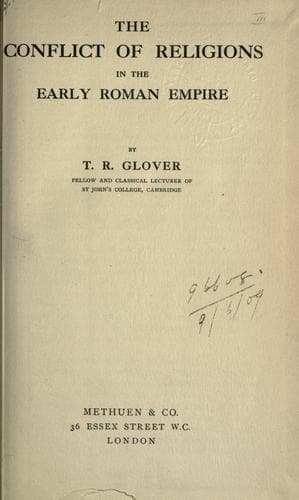
The Conflict of Religions in the Early Roman EmpireGlover, T. R. (Terrot Reaveley)
Religion
The Conflict of Religions in the Early Roman Empire
Glover, T. R. (Terrot Reaveley)
Christianity and other religions; Church history -- Primitive and early church, ca. 30-600; Rome -- Religion
Celsus did not bring against the Christians the charges of "OEdipodean
unions and Thyestean banquets" familiar to the reader of the
Apologists[108]--and to the student of the events that preceded the
Boxer movement in China. While he taunted Jesus with being a bastard
and a deceiver, and roundly denounced Christians generally for imposing
upon the ignorance of men with false religion and false history, he did
not say anything of note against ordinary Christian conduct. At least
the fragments do not show anything of the kind. Later on the defenders
and apologists of paganism had to own with annoyance that Christians
set their fellow-citizens an example; Maximin Daza and Julian tried
vigorously to raise the tone of pagan society. Here lies an argument
with which Celsus could not deal. The Fatherhood of God (in the sense
which Jesus gave to the words) and the value of the individual soul,
even the depraved and broken soul, are matters of argument, and on
paper they may be very questionable; but when the people, who held or
(more truly) were held by these beliefs, managed somehow or other to
show to the world lives transformed and endowed with the power of
transforming others, the plain fact outweighed any number of _True
Words_. Whatever {261} the explanation, the thing was there.
Christians in the second century laid great stress on the value of
paper and argument, and to-day we feel with Celsus that among them,
orthodox and heretical, they talked and wrote a great deal that was
foolish--"their allegories were worse than their myths"--but the sheer
weight of Christian character carried off allegories and myths, bore
down the school of Celsus and the more powerful school of Plutarch,
Porphyry and Plotinus and abolished the ancient world, and then
captured and transformed the Northern nations.
Celsus could not foresee all that we look back upon. But it stands to
his credit that he recognised the dangers which threatened the ancient
civilization, dangers from German without and Christian within. He had
not the religious temperament; he was more the statesman in his habit
of mind, and he clearly loved his country. The appeal with which he
closes is a proposal of peace--toleration, if the Christians will save
the civilized world. It was not destined that his hopes should be
fulfilled in the form he gave them, for it was the Christian Church
that subdued the Germans and that carried over into a larger and more
human civilization all that was of value in that inheritance of the
past for which he pleaded. So far as his gifts carried him, he was
candid; and if sharp of tongue and a little irritable of temper, he was
still an honourable adversary. He was serious, and, if he did not
understand religion, he believed in the state and did his best to save
it.
Chapter VIII Footnotes:
[1] Keim, _Celsus' Wahres Wort_ (1873).
[2] Keim, pp. 264-273.
Public-domain text, read in full here on John Shaqi.
Reviews
Reviews
No reviews yet
Be the first to share your thoughts on this work.
Elsewhere in the archive
Join the Discussion
Join the discussion
Sign in to leave a comment or review.
Sign InorCreate an account