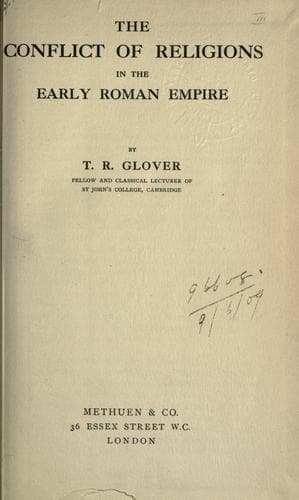
The Conflict of Religions in the Early Roman EmpireGlover, T. R. (Terrot Reaveley)
Religion
The Conflict of Religions in the Early Roman Empire
Glover, T. R. (Terrot Reaveley)
Christianity and other religions; Church history -- Primitive and early church, ca. 30-600; Rome -- Religion
[3] Tertullian, _Apol._ 38, _nec ulla res aliena magis quam publica_.
Elsewhere Tertullian explains this: _laedimas Romanos nec Romani habemur
qui non Romanorum deum colimus, Apol._ 24.
[4] Apud Origen, _c. Cels._ viii, 2. References in what follows will
be made to the book and chapter of this work without repetition of
Origen's name. The text used is that of Koetschau.
[5] _c. Cels._ iii, 44.
[6] _Ibid._ iii, 59.
[7] iii, 55. I have omitted a clause or two.
Clem A. _Strom._ iv, 67, on the other hand, speaks of the difficult
position of wife or slave in such a divided household, and (68) of
conversions in spite of the master of the house. Tert. _ad Scap._ 3,
has a story of a governor whose wife became a Christian, and who in
anger began a persecution at once.
[8] iii, 75.
[9] i, 9. Cf. Clem. Alex. _Strom._ i, 43, on some Christians who think
themselves _euphusis_ and "ask for faith--faith alone and bare." In
_Paed._ i, 27, he says much the same himself, _to pisteusai monon kai
anagennethunai teleiois estin en zoe_.
[10] vi, 10. Clem. Alex. _Strom._ ii, 8, "The Greeks think Faith empty
and barbarous, and revile it," but (ii, 30) "if it had been a human
thing, as they supposed, it would have been quenched."
[11] iii, 62.
[12] iii, 62.
[13] iii, 65, _tous hamartangin pephykotas te kai eithismenous_.
[14] iii, 71.
[15] Clement of Alexandria, _Protr._ 92, uses this simile of worms in
the mud of swamps, applying it to people who live for pleasure.
[16] iv, 23.
[17] iv, 74.
[18] So Lucian _Icaromenippus_, 19, explicitly.
[19] iv, 88. Cf. Clem. Alex. _Paedag._ i, 7, _to philtron endon estin
en to anthropo touth' oper emphysema legetai theou_.
[20] _c. Cels._ iv, 74-99. Cf. Plato, _Laws_, 903 B, _hos to tou
pantos epimeloumeno pros ten soterian kai areten tou holou pant' esti
syntetagmena kte_, explicitly developing the idea of the part being for
the whole. Also Cicero, _N.D._ ii, 13, 34-36.
[21] Of. M. Aurelius, xi, 3, the criticism of the theatricality of the
Christians. See p. 198.
[22] _c. Cels._ vii, 42, _ton men oun poieten kai patera toude tou
pantos ehurein te epgon kai ehuronta eis pantas adynaton legein_;
_Timaeus_, 28 C--often cited by Clement too.
[23] vii, 42.
[24] vii, 42.
[25] vii, 45.
[26] iv, 14.
[27] iv, 18. See Tertullian's argument on this question of God
changing, in _de Carne Christi_, 3. See Plato, _Rep._ ii, 381 B.
[28] iv, 52. See _Timaeus_, 34 B ff. on God making soul.
Public-domain text, read in full here on John Shaqi.
Reviews
Reviews
No reviews yet
Be the first to share your thoughts on this work.
Elsewhere in the archive
Join the Discussion
Join the discussion
Sign in to leave a comment or review.
Sign InorCreate an account