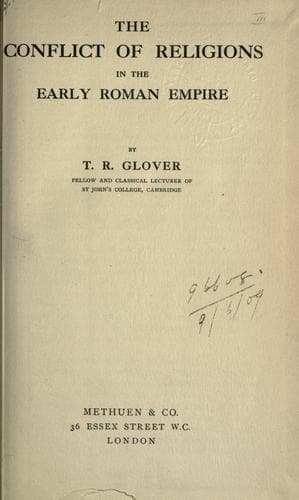
The Conflict of Religions in the Early Roman EmpireGlover, T. R. (Terrot Reaveley)
Religion
The Conflict of Religions in the Early Roman Empire
Glover, T. R. (Terrot Reaveley)
Christianity and other religions; Church history -- Primitive and early church, ca. 30-600; Rome -- Religion
[29] iv, 73. See Clem. Alex. _Paed._ i, ch. 10, on God threatening;
and Strom, ii, 72; iv, 151; vii, 37, for the view that God is without
anger, and for guidance as to the understanding of language in the O.T.
which seems to imply the contrary. For a different view, see
Tertullian, _de Testim. Animae_, 2, _unde igitur naturalis timor animae
in deum, si deus nan novit irasci? adv. Marc._ i, 26, 27, on the
necessity for God's anger, if the moral law is to be maintained; and
_adv. Marc._ ii, 16, a further account of God's anger, while a literal
interpretation of God's "eyes" and "right hand" is excluded.
[30] iv, 65.
[31] iv, 69.
[32] iv, 70. Long before (about 500 B.C.)
Heraclitus had said (fragm. 61): "To
God all things are beautiful and good and just; but men have supposed
some things to be unjust and others just." For this doctrine of the
relativity of good and bad to the whole, cf. hymn of Cleanthes to
Zeus:--
_alla su kai ta perissa t' epistasai artia theinai_,
_kai kosmein ta kosma, kai ou phila soi phila estin_.
_ode gar eis en panta synermokas esthla kakoisin_
_osth' ena gignesthai panton logon aien eonta_.
Cf. also the teaching of Chrysippus, as given by Gellius, _N.A._ vii,
1: _cum bona malis contraria sint, utraque necessum est opposita inter
sese et quasi mutuo adverse quaeque fulta nisu consistere; nullum adeo
contrarium est sine contrario altero ... situleris unum abstuleris
utrumque_. See also M. Aurelius in the same Stoic vein, viii, 50; ix,
42. On the other side see Plutarch's indignant criticism of this
attribution of the responsibility for evil to God, _de comm. not. adv.
Sto._ 14, 1065 D, ff. In opposition to Marcion, Tertullian emphasizes
the worth of the world; his position, as a few words will show, is not
that of Celsus, but Stoic influence is not absent: _adv. Marc._ i, 13,
14; _Ergo nec mundus deo indignus: nihil etenim deus indignum st fecit,
etsi mundum homini non sibi fecit, etsi omne opus inferius est suo
artifice_; see p. 317.
[33] iv, 3.
[34] iv, 6.
[35] iv, 7.
[36] vii, 36.
[37] viii, 63.
[38] viii, 66.
[39] vi, 69. "Men, who count themselves wise," says Clement (_Strom._
i, 88), "count it a fairy tale that the son of God should speak through
man, or that God should have a son, and he suffer."
[40] vi, 72.
[41] vi, 73. Cf. the Marcionite view; cf. Tert. _adv. Marc._ iii, 11;
iv, 21; v, 19, _cuius ingeniis tam longe abest veritas nostra ut ...
Christum ex vulva virginis natum non erubescat, ridentibus philosophis
et haereticis et ethnicis ipsis_. See also _de carne Christi_, 4, 5,
where he strikes a higher note; Christ loved man, born as man is, and
descended for him.
[42] vi, 75. Cf. Tert. _de carne Christi_, 9, _adeo nec humanae
honestatis corpus fuit; adv. Jud._ 14, _ne aspectu quidem honestus_.
[43] vi, 78. Cf. Tert. _adv. Marc._ iii, i, _atquin nihil putem a deo
subitum quia nihil a deo non dispositum_.
Public-domain text, read in full here on John Shaqi.
Reviews
Reviews
No reviews yet
Be the first to share your thoughts on this work.
Elsewhere in the archive
Join the Discussion
Join the discussion
Sign in to leave a comment or review.
Sign InorCreate an account