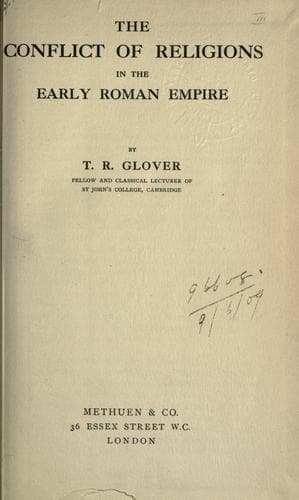
The Conflict of Religions in the Early Roman EmpireGlover, T. R. (Terrot Reaveley)
Religion
The Conflict of Religions in the Early Roman Empire
Glover, T. R. (Terrot Reaveley)
Christianity and other religions; Church history -- Primitive and early church, ca. 30-600; Rome -- Religion
[44] vii, 13, _skataophagein_. Origen's reply is absurd--_hina gar kai
doxe hoti hesthein, hos soma phoron ho Iesous hesthein_. So also said
Clement (_Strom._ vi, 71). Valentinus had another theory no better,
_Strom._ iii. 59. Marcion, Tertullian says (_adv. Marc._ iii, 10),
called the flesh _terrenam et stercoribus infusam_. They are all
filled with the same contempt for matter--not Tertullian, however.
[45] i, 69.
[46] i, 54.
[47] i, 12.
[48] ii, 23, 24.
[49] ii, 34.
[50] ii, 37.
[51] ii, 66, 67. Tertullian meets this in _Apol._ 21. _Nam nec ille
se in vulgus eduxit ne impii errore liberarcntur, ut et fides, non
mediocri praemio destinata, difficultate constaret_.
[52] ii, 68,
[53] viii, 39.
[54] viii, 41.
[55] v, 65.
[56] vi, 34. Cf. a curious passage of Clem. Alex. _Protr._ 114, _outos
ten dusin eis anatolen metegagen kai ton thanaton eis zoen anestaursen
exarpasas de tes apoleias ton anthropon prosekremasen aitheri_, and so
forth. Cf. Tert. _adv. Valent._ 20, who suggests that the Valentinians
had "nut-trees in the sky"--it is a book in which he allows himself a
good deal of gaiety and free quotation.
[57] i, 28.
[58] M. Aurelius, i, 6, "From Diognetus I learnt not to give credit to
what was said by miracle-workers and jugglers (_goeton_) about
incantations and the sending away of daemons and such things." Cf.
Tertullian, _adv. Marc._ iii, 2-4, on inadequacy of proof from miracles
alone, without that from prophecy; also _de Anima_, 57, on these
conjurers, where he remarks, _nec magnum illi exteriores oculos
circumscribere, an interiorem mentis aciem excalcare perfacile est_.
See also _Apol._ 22, 23.
[59] i, 68.
[60] vii, 9.
[61] iii, 36.
[62] vi, 16. Cf. Plato, _Laws_, v, 12, p. 743 A.
[63] vi, 17-19; _Phaedrus_, 247 C.
[64] vi, 42.
[65] vii, 32; cf. Min. Felix, 11, 9.
[66] iv, 11.
[67] vi, 8.
[68] vi, 47. Cf. Plato, _Timaeus_ (last words), 92 C, _eis ouranos ode
monogenes on_.
[69] v, 14.
[70] v, 14.
[71] vii, 34.
[72] viii, 49.
[73] viii. 48.
[74] iii, 14.
[75] v, 59.
[76] iii, 12.
[77] vi, II.
[78] iii, 9. Tertullian speaks in a somewhat similar way of heretics,
especially of the Gnostics: _de praescriptione haeret_. c. 42.
[79] vii, 68.
[80] v, 25.
[81] viii, 53, 58.
[82] vii, 68.
[83] vii, 2.
[84] Cf. v, 34, 35.
[85] viii, ii. Cf. Tert. _adv. Prax._ 3, where it is argued that God's
monarchy is not impaired _tot angelorum numero_, nor by the _oikonomia_
of the Trinity.
[86] v, 41.
[87] v, 41.
[88] viii, 45.
[89] vii, 35.
[90] iii, 24. Cf. p. 222.
[91] viii, 35.
[92] viii, 63.
[93] viii, 12.
[94] vii, 68.
[95] viii, 24.
[96] i, 9, _Mithrais kai Sabadiois_.
[97] viii, 60. See note on ch. iii, p. 107.
[98] viii, 67.
Public-domain text, read in full here on John Shaqi.
Reviews
Reviews
No reviews yet
Be the first to share your thoughts on this work.
Elsewhere in the archive
Join the Discussion
Join the discussion
Sign in to leave a comment or review.
Sign InorCreate an account