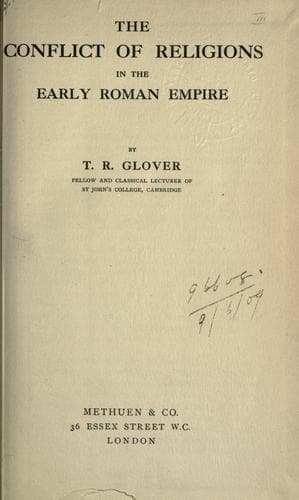
The Conflict of Religions in the Early Roman EmpireGlover, T. R. (Terrot Reaveley)
Religion
The Conflict of Religions in the Early Roman Empire
Glover, T. R. (Terrot Reaveley)
Christianity and other religions; Church history -- Primitive and early church, ca. 30-600; Rome -- Religion
It was this strong sympathy with the simplest view of the Christian
faith that made the life-work of Clement possible. He was to go far
outside the ordinary thoughts of the Christian community round about
him--inevitably he had to do this under the compulsion of his wide
experience of books and thinkers--but the centre of all his larger
experience he found where his unlettered friends, "believing without
letters," found their centre, and he checked his theories, original and
borrowed--or he aimed at checking them--by life. "As in gardening and
in medicine he is the man of real learning (_chrestomathes_), who has
had experience of the more varied lessons...; so, I say, here too, of
him who brings everything to bear on the truth.... We praise the pilot
of wide range, who 'has seen the cities of many men'... so he who turns
everything to the right life, fetching illustrations from things Greek
and things barbarian alike, he is the much-experienced (_polypeiros_)
tracker of truth, the real _polymetis_; like the touchstone--the Lydian
stone believed to distinguish between the bastard and the true-born
gold, he is able to separate,--our _polyidris_ and man of knowledge
(_gnostikos_) as he is,--sophistic from philosophy, the cosmetic art
from the true gymnastic, cookery from medicine, rhetoric from
dialectic, magic and other heresies in the barbarian philosophy from
the actual truth."[41] This, in spirit and letter, is a very
characteristic utterance. Beginning with the Lord as "the vine"--from
which some expect to gather clusters of grapes in the twinkling of an
eye--he ranges into medicine and sea-faring, from Odysseus "of many
wiles, who saw the cities of many men and learnt their mind," to
Plato's _Gorgias_, and brings all to bear on the Christian life. What
his simple friends made of such a passage--if they were able to read at
all, or had it read to them--it is not easy to guess, but contact must
have shown them in the man a genuine and tender Christian as
Christocentric as themselves, if in speech he {274} was oddly
suited,--a gay epitome of Greek literature in every sentence.
Public-domain text, read in full here on John Shaqi.
Reviews
Reviews
No reviews yet
Be the first to share your thoughts on this work.
Elsewhere in the archive
Join the Discussion
Join the discussion
Sign in to leave a comment or review.
Sign InorCreate an account