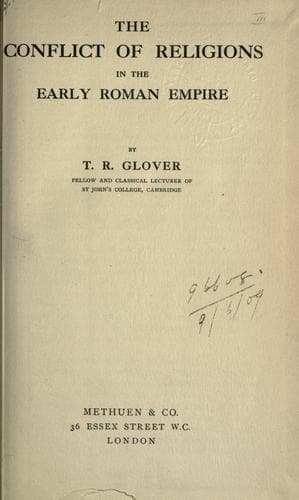
The Conflict of Religions in the Early Roman EmpireGlover, T. R. (Terrot Reaveley)
Religion
The Conflict of Religions in the Early Roman Empire
Glover, T. R. (Terrot Reaveley)
Christianity and other religions; Church history -- Primitive and early church, ca. 30-600; Rome -- Religion
This, then, is the man, a Greek of wide culture and open heart, who has
dipped into everything that can charm the fancy and make the heart
beat,--curious in literature, cult, and philosophy, and now submitted
to the tradition of the church and the authority of Hebrew prophet and
Christian apostle, but not as one bowing to a strange and difficult
necessity. Rather, with the humblest of God's children--those "tender,
simple and guileless" children on whom God lavishes all the little
names which he has for his only Son, the "lamb" and the "child"[42]--he
finds in Christ "thanksgiving, blessing, triumph and joy," while Christ
himself bends from above, like Sarah, to smile upon their
"laughter."[43] Such was the range of Clement's experience, and now,
under the influence of the great change that conversion brought, he had
to re-think everything and to gather it up in a new unity. Thus in one
man were summed up all the elements of import in the general situation
of the church of his day. He was representative alike in his
susceptibility to the ancient literature and philosophy and his love of
Scripture--"truth-loving Isaiah" and "St Paul"--in his loyalty to the
faith, and, not less, in his determination to reach some higher ground
from which the battle of the church could be fought with wider outlook,
more intelligent grasp of the factors in play, and more hope of winning
men for God.
[Sidenote: Faith and philosophy]
Clement did not come before his time. Philosophy had begun to realize
the significance of the church. The repression of the "harmful
superstition" was no longer an affair of police; it was the common
concern of good citizens. The model Emperor himself, the philosopher
upon the throne, had openly departed from the easy policy laid down by
Trajan and continued by his successors. He had witnessed, or had
received reports of, executions. Writing in his diary of death, he
says: "What a soul is that which is ready, if the moment has come for
its separation from the body, whether it is to be extinguished, or
dissolved, or to continue a whole. This readiness--see that it come
from your own judgment, not in mere obstinacy, as with the Christians,
but reflectively and {275} with dignity, in a way to persuade another,
with nothing of the actor in it."[44] This sentence betrays something
of the limitations of a good man--a beautiful spirit indeed, but not a
little over-praised by his admirers in modern days. Celsus at once
taunts his Christian opponents with their prospects of painful death
and demonstrates the absurdity of their tenets from the point of view
of philosophy. The Apologists say, too, that the philosophers lent
themselves (as did also the daemons) to inciting the mob to massacre.
But after all the dialectical weapons of Philosophy were the more
dangerous, for they shook the faith of the Christian which death did
not shake.
Public-domain text, read in full here on John Shaqi.
Reviews
Reviews
No reviews yet
Be the first to share your thoughts on this work.
Elsewhere in the archive
Join the Discussion
Join the discussion
Sign in to leave a comment or review.
Sign InorCreate an account