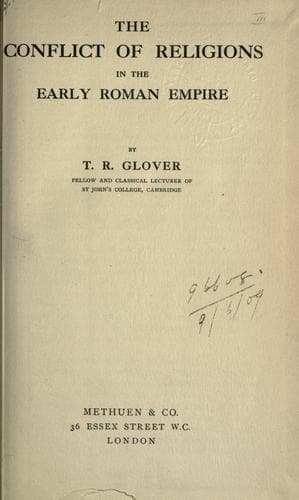
The Conflict of Religions in the Early Roman EmpireGlover, T. R. (Terrot Reaveley)
Religion
The Conflict of Religions in the Early Roman Empire
Glover, T. R. (Terrot Reaveley)
Christianity and other religions; Church history -- Primitive and early church, ca. 30-600; Rome -- Religion
Again, the candid and inquiring temper of some notable converts and
friends had led them to question the tradition of the church and to
examine their Christian experience with a freedom from prejudice, at
least in the evangelic direction, which had resulted in conclusions
fatal, it seemed, to the Christian movement. Their philosophy had
carried them outside the thoughts of Jesus--they had abandoned the idea
of the Abba Father, of the divine love, of the naturalness and
instinctiveness of Christian life. Incarnation and redemption they
rejected, at least in the sense which made the conceptions of value to
men. Jesus they remodelled into one and another figure more amenable
to their theories--a mere man, a demi-god, a phantom, into anything but
the historic personality that was and could remain the centre and
inspiration of Christian life. Of all this mischief philosophy, men
said, was the cause.[45]
"I know quite well," writes Clement, "what is said over and over again
by some ignorantly nervous people who insist that we should confine
ourselves to the inevitable minimum, to what contains the faith, and
pass over what is outside and superfluous, as it wears us out to no
purpose and occupies us with what contributes nothing to our end.
Others say philosophy comes of evil and was introduced into life for
the ruin of {276} men by an evil inventor."[46] They were afraid of
philosophy, as children might fear a ghost, in case it should take them
away[47]--but this, as Clement saw, was no way to meet the danger. The
Christian must not philosophize, they said--Tertullian said it too; but
how could they know they must not philosophize unless they
philosophized?[48] Whether philosophy is profitable or not, "you
cannot condemn the Greeks on the basis of mere statements about their
opinions, without going into it with them till point by point you
discover what they mean and understand them. It is the refutation
based upon experience that is reliable."[49]
[Sidenote: His defence of philosophy]
So Clement has first of all to fight the battle of education inside the
church, to convince his friends that culture counts, that philosophy is
inevitable and of use at once for the refutation of opponents and for
the achievement of the full significance of faith. Then he has to show
how philosophy at its best was the foe of superstition and the champion
of God's unity and goodness--a preparation for the Gospel. Lastly he
has to restate the Christian position in the language of philosophy and
to prove that the Gospel is reaffirming all that was best in the
philosophic schools and bringing it to a higher point, indeed to the
highest; that the Gospel is the final philosophy of the universe, the
solution of all the problems of existence, the revelation of the
ultimate mind of God.
Public-domain text, read in full here on John Shaqi.
Reviews
Reviews
No reviews yet
Be the first to share your thoughts on this work.
Elsewhere in the archive
Join the Discussion
Join the discussion
Sign in to leave a comment or review.
Sign InorCreate an account