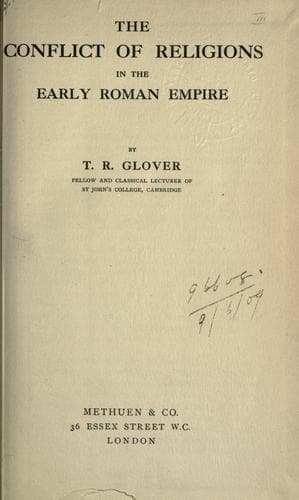
The Conflict of Religions in the Early Roman EmpireGlover, T. R. (Terrot Reaveley)
Religion
The Conflict of Religions in the Early Roman Empire
Glover, T. R. (Terrot Reaveley)
Christianity and other religions; Church history -- Primitive and early church, ca. 30-600; Rome -- Religion
The impulse to Philosophy is an inevitable one, native to the human
mind, and he shows that it is to the Divine Reason working in all
things, to Providence, that we must attribute it. {278} "Everything,
so far as its nature permits, came into being, and does so still,
advancing to what is better than itself. So that it is not out of the
way that Philosophy too should have been given in Divine Providence, as
a preliminary training towards the perfection that comes by Christ....
'Your hairs are numbered' and your simplest movements; can Philosophy
be left out of the account? [An allegory follows from Samson's hair.]
Providence, it says, from above, from what is of first importance, as
from the head, reaches down to all men, as 'the myrrh,' it says, 'that
descends upon Aaron's beard and to the fringe of his garment'--viz.:
the Great High Priest, 'by whom all things came into being, and without
him nothing came'--not, that is, on to the beauty of the body;
Philosophy is outside the people [possibly Israel is meant] just as
raiment is. The philosophers then, who are trained by the perceptive
spirit for their own perception,--when they investigate not a part of
Philosophy, but Philosophy absolutely, they testify in a truth-loving
way and without pride to truth by their beautiful sayings even with
those who think otherwise, and they advance to understanding
(_synesin_), in accordance with the divine dispensation, that
unspeakable goodness which universally brings the nature of all that
exists onward toward the better so far as may be."[54]
Thought (_phronesis_) takes many forms, and it is diffused through all
the universe and all human affairs, and in each sphere it has a
separate name--Thought, Knowledge, Wisdom or Faith. In the things of
sense it is called Right Opinion; in matters of handicraft, Art; in the
logical discussion of the things of the mind, it is Dialectic. "Those
who say that Philosophy is not from God, come very near saying that God
cannot know each several thing in particular and that He is not the
cause of all good things, if each of them is a particular thing.
Nothing that is could have been at all without God's will; and, if with
His will, then Philosophy is from God, since He willed it to be what it
is for the sake of those who would not otherwise abstain from evil."
"He seeth all things and he heareth all[55]
{279}
Public-domain text, read in full here on John Shaqi.
Reviews
Reviews
No reviews yet
Be the first to share your thoughts on this work.
Elsewhere in the archive
Join the Discussion
Join the discussion
Sign in to leave a comment or review.
Sign InorCreate an account