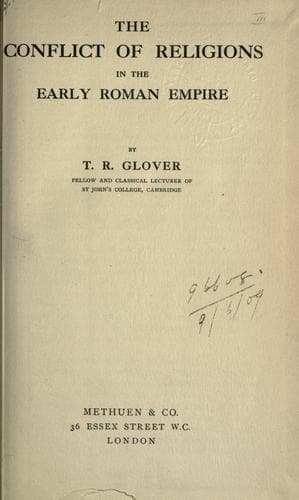
The Conflict of Religions in the Early Roman EmpireGlover, T. R. (Terrot Reaveley)
Religion
The Conflict of Religions in the Early Roman Empire
Glover, T. R. (Terrot Reaveley)
Christianity and other religions; Church history -- Primitive and early church, ca. 30-600; Rome -- Religion
and beholds the soul naked within, and he has through all eternity the
thought (_epinoia_) of each several thing in particular," seeing all
things, as men in a theatre look around and take all in at a glance.
"There are many things in life that find their beginning in human
reason, though the spark that kindles them is from God.[56] Thus
health through medicine, good condition through training, wealth
through commerce, come into being and are amongst us, at once by Divine
Providence and human co-operation. And from God comes understanding
too. And the free will (_proairesis_) of good men most of all obeys
God's will.... The thoughts (_epinoiai_) of virtuous men come by
divine inspiration (_epipnoia_), the soul being disposed so and the
divine will conveyed (_diadidonenou_) to human souls, the divine
ministers taking part in such services; for over all nations and cities
are assigned angelic governances--perhaps even over individuals."[57]
Philosophy makes men virtuous, so it cannot be the product of
evil--that is, it is the work of God. As it was given to the best
among the Greeks, we can divine who was the Giver.[58]
This is a favourite thought with Clement, and, as he does with all
ideas that please him, he repeats it over and over again, in all sorts
of connexions and in all variety of phrase. When a man is avowedly
making "patchwork" books (_Stromateis_), there is really no occasion on
which we can call it irrelevant for him to repeat himself, and this is
a thought worth repeating. "Before the advent of the Lord, Philosophy
was necessary to the Greeks for righteousness, and it is still
profitable for piety, a sort of primary instruction for those who reap
faith by revelation.... God is the cause of all good things, of some
directly, as of the Old and New Testament, of others indirectly as of
Philosophy. And perhaps even directly it was given in those times to
the Greeks, before the Lord called the Greeks also; for Philosophy too
was a _paidagogos_ for the Greek world, as the Law was for the Hebrews,
to bring them to Christ."[59] {280} "Generally speaking, we should not
be wrong in saying that all that is necessary and profitable to life
comes to us from God--and that Philosophy was more especially given to
the Greeks, as a sort of covenant (_diatheke_) of their own, a step
(_hypobathra_) toward the Philosophy according to Christ,--if Greek
philosophers will not close their ears to the truths, through contempt
of the barbarian speech."[60] "God is the bestower (_choregos_) of
both covenants, who also gave Philosophy to the Greeks, whereby among
the Greeks the Almighty is glorified."[61] "In those times Philosophy
by itself 'justified' the Greeks--though not to the point of perfect
righteousness."[62] "As in due season the Preaching now comes, so in
due season the law and the prophets were given to the barbarians and
Philosophy to the Greeks, to train their ears for the Preaching."[63]
[Sidenote: The origin of philosophy]
Public-domain text, read in full here on John Shaqi.
Reviews
Reviews
No reviews yet
Be the first to share your thoughts on this work.
Elsewhere in the archive
Join the Discussion
Join the discussion
Sign in to leave a comment or review.
Sign InorCreate an account