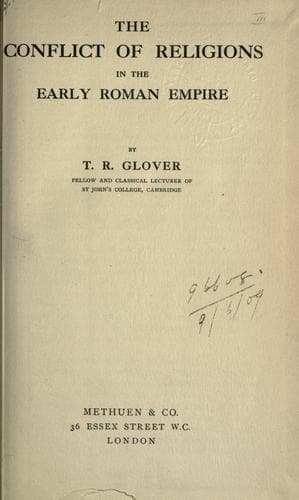
The Conflict of Religions in the Early Roman EmpireGlover, T. R. (Terrot Reaveley)
Religion
The Conflict of Religions in the Early Roman Empire
Glover, T. R. (Terrot Reaveley)
Christianity and other religions; Church history -- Primitive and early church, ca. 30-600; Rome -- Religion
Philosophy however fell short of the Law. Those, who were righteous by
the Law, still lacked Faith; while the others, whose righteousness was
by Philosophy, not only lacked Faith but failed to break with
idolatry.[64] (This was in many quarters the capital charge against
contemporary philosophy.) It was for this reason that the Saviour
preached the Gospel in Hades, just as after him, according to Hermas,
"the apostles and teachers, when they fell asleep in the power and
faith of the Son of God, preached to those who had fallen asleep before
them."[65] It is curious that Clement not only cites Philosophy as a
gift of God to the Gentiles before Faith came, that God's judgments
might be just, but he also says, on the authority of the Law (quoting
inaccurately and perhaps from memory), that God gave them the sun, the
moon and stars to worship, which God made for the Gentiles that they
might not become utterly atheistic and so utterly perish. "It was a
road given to them, that in worshipping the stars they might look up to
God."[66] That they fell into idolatry was however only too patent a
fact.
{281}
The exact means, by which the Greeks received the truths contained in
their philosophy, is not certain. A favourite explanation with
Christian writers, and one to which Clement gives a good deal of
thought, is that Greek thinkers borrowed at large from the Old
Testament, for Moses lived some six hundred years before the
deification of Dionysos, the Sibyl long before Orpheus.[67] Clement's
illustrations are not very convincing. "The idea of bringing
Providence as far down as the moon came to Aristotle from this _Psalm_:
'Lord, in heaven is thy mercy and thy truth as far as (_heos_) the
clouds.'" Epicurus took his conception of Chance from "Vanity of
vanities, all is vanity;" while the Sabbath is found in several lines
of Homer--unfortunately spurious. An attempt to convict Euripides of
plagiarism from Plato's _Republic_ shows the worth of these
suggestions, and the whole scheme wakes doubts as to the value of
Clement's judgment.[68]
Another theory was angelic mediation. God might have communicated with
the Greeks by inferior angels;[69] or those angels who fell into
pleasure might have told their human wives what they knew of divine
secrets, "and so the doctrine of Providence got about."[70] Or else by
happy guess or accident the Greeks found parts of the truth for
themselves--or in virtue of some naturally implanted notion (_ennoia_)
or common mind, and then "we know who is the author of nature."[71]
Public-domain text, read in full here on John Shaqi.
Reviews
Reviews
No reviews yet
Be the first to share your thoughts on this work.
Elsewhere in the archive
Join the Discussion
Join the discussion
Sign in to leave a comment or review.
Sign InorCreate an account