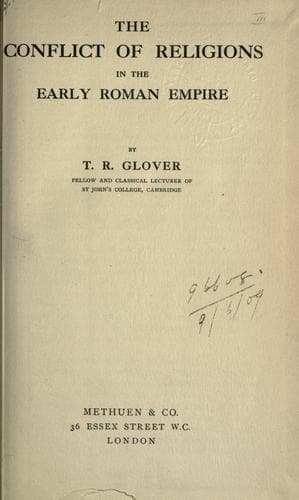
The Conflict of Religions in the Early Roman EmpireGlover, T. R. (Terrot Reaveley)
Religion
The Conflict of Religions in the Early Roman Empire
Glover, T. R. (Terrot Reaveley)
Christianity and other religions; Church history -- Primitive and early church, ca. 30-600; Rome -- Religion
Whatever the explanation, in any case the hand of God was to be traced
in it--Providence foreknew all, and so designed that the wickedness of
fallen angels and men should promote righteousness and truth.[72] So
much for those who quote the text "All that ever came before me were
thieves and robbers,"[73] or who say that the devil is the author of
{282} Philosophy[74] (though we may admit Epicureanism to have been
sown by the sower of tares).[75] We might look far for a more vivid
illustration of the contrast between sound instinct and absurd theory.
[Sidenote: The _Protrepticus_]
Thus he vindicates the right of the Christian to claim Philosophy as
the manifestation of the Divine Logos, and as a fore-runner of the
Gospel, and in his _Protrepticus_ he shows how the Christian thus
re-inforced can deal with paganism. If the _Stromateis_ weary even the
sympathetic reader with their want of plan, their diffuseness and
repetition, and their interminable and fanciful digressions--faults
inherent in all works of the kind--the _Protrepticus_ makes a different
impression. It is written by the same hand and shows the same
tendencies, but they are under better control. Allegories, analogies
and allusions still hinder the development of his thought--like
Atalanta he can never let a golden apple run past him. He is not
properly a philosopher in spite of all his love of Philosophy, and he
thinks in colours, like a poet. Yet he is not essentially a man of
letters or a poet; he is too indolent; his style is not inevitable or
compulsive. It is too true a confession when he says that he does not
aim at beauty of language. His sentence will begin well, and then grow
intricate and involved--in breaks an allusion, not always very
relevant, and brings with it a quotation that has captured his fancy
and paralyses his grammar--several perhaps--some accommodation is made,
and the sentence straggles on, and will end somehow--with a pile of
long words, for which others have been patiently waiting since before
the quotation, in pendent genitives, accusatives and so forth. But in
the _Protrepticus_--in the better parts of it--something has happened
to his style, for (to speak after his own manner)
Nothing of him that doth fade,
But doth suffer a sea-change
Into something rich and strange.
He is no longer arguing; he surrenders to a tide of emotion, and is
borne along singing, and as he sings, he seems to gather up all the
music of the ancient world; we catch notes that come from Greek and
Hebrew song, and the whole is woven together {283} into a hymn to "the
Saviour," "my Singer," "our new Orpheus," that for sheer beauty, for
gladness and purity of feeling is unmatched in early Christian
literature. One comes back to it after years and the old charm is
there still. That it can survive in a few translated fragments is
hardly to be expected.
Public-domain text, read in full here on John Shaqi.
Reviews
Reviews
No reviews yet
Be the first to share your thoughts on this work.
Elsewhere in the archive
Join the Discussion
Join the discussion
Sign in to leave a comment or review.
Sign InorCreate an account