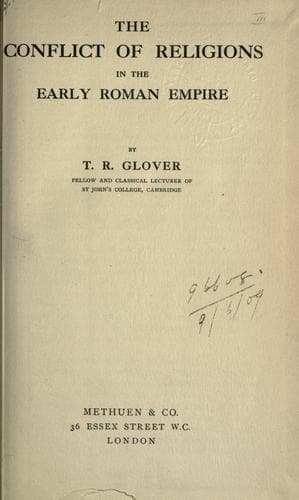
The Conflict of Religions in the Early Roman EmpireGlover, T. R. (Terrot Reaveley)
Religion
The Conflict of Religions in the Early Roman Empire
Glover, T. R. (Terrot Reaveley)
Christianity and other religions; Church history -- Primitive and early church, ca. 30-600; Rome -- Religion
In the passages here quoted from the _Protrepticus_ some of Clement's
main ideas in the realm of Christian thought are clearly to be seen;
and we have now to give them further and more detailed examination. We
have to see what he makes of the central things in the new religion--of
God, and the Saviour, and of man, and how he interprets the Gospel of
Jesus in the language of Greek philosophy. It is to be noted that,
whatever happened in the course of his work--and very few books are,
when written, quite what the writer expected on beginning--Clement
looked upon his task as interpretation. The Scriptures are his
authorities--"he who has believed the divine Scriptures, with firm
judgment, receives in the voice of God who gave the Scriptures a proof
that cannot be spoken against."[101] Amid the prayers and hymns of the
ideal Christian comes daily reading of the sacred books.[102] Clement
has no formal definition of inspiration, but he loved the sacred text,
and he made it the standard by which to judge all propositions. It is
perhaps impossible to over-estimate the importance of this loyalty in
an age, when Christian speculation was justly under suspicion on
account {288} of the free re-modelling of the New Testament text that
went with it. Clement would neither alter, nor excise, but he found
all the freedom he wanted in the accepted methods of exegesis.
Allegory and the absence of any vestige of historical criticism--and,
not least, the inability induced by the training of the day to conceive
of a work of art, or even a piece of humbler literature, as a
whole--his very defects as a student secured his freedom as a
philosopher. He can quote Scripture for his purpose; the phrase will
support him where the context will not; and sometimes a defective
memory will help him to the words he wants, as we have seen in the case
of the worship of sun, moon and stars. To the modern mind such a use
of Scripture is unwarrantable and seems to imply essential indifference
to its real value, but in Clement and his contemporaries it is not
inconsistent with--indeed, it is indicative of--a high sense of the
value of Scripture as the _ipsissima verba_ of God. And after all a
mis-quotation may be as true as the most authentic text, and may help a
man as effectually to insight into the thoughts of God.
[Sidenote: The Logos]
Public-domain text, read in full here on John Shaqi.
Reviews
Reviews
No reviews yet
Be the first to share your thoughts on this work.
Elsewhere in the archive
Join the Discussion
Join the discussion
Sign in to leave a comment or review.
Sign InorCreate an account