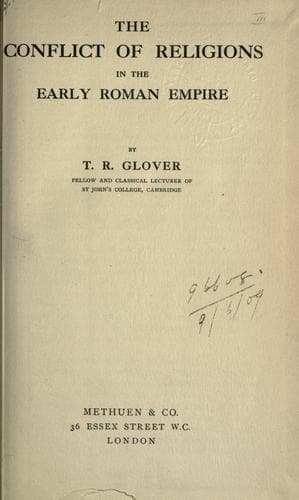
The Conflict of Religions in the Early Roman EmpireGlover, T. R. (Terrot Reaveley)
Religion
The Conflict of Religions in the Early Roman Empire
Glover, T. R. (Terrot Reaveley)
Christianity and other religions; Church history -- Primitive and early church, ca. 30-600; Rome -- Religion
We have seen that Clement quarrelled with the Stoics for involving God
in matter--"even the most dishonourable." The World-soul was, in fact,
repugnant to men who were impressed with the thought of Sin, and who
associated Sin with matter. This feeling and a desire to keep the idea
of God disentangled from every limitation led to men falling back (as
we saw in the case of Plutarch) on the Platonic conception of God's
transcendence. Neo-Platonism has its "golden chain" of existence
descending from Real Being--God--through a vast series of beings who
_are_ in a less and less degree as they are further down the scale. It
is not hard to sympathize with the thoughts and feelings which drew men
in this direction. The best thinkers and the most religious natures in
the Mediterranean world (outside the circle of Jesus, and some Stoics)
found the transcendence of God inevitably attractive, and then their
hearts sought means to bridge the gulf their thoughts had made. For
now he was out of all knowledge, and away beyond even revelation; for
revelation involved relation and limitation, and God must be absolute.
{289}
We have seen how Plutarch found in the existence of daemons a
possibility of intercourse between gods and men, while above the daemons
the gods, he implies, are in communication with the remote Supreme.
But for some thinkers this solution was revolting. Philo, with the
great record before him of the religious experience of his race, was
not prepared to give up the thought "O God, thou art my God."[103]
Linking the Hebrew phrase "the word of the Lord" with the Stoic Logos
Spermaticos and Plato's Idea, he found in the resulting conception a
divine, rational and spiritual principle immanent in man and in the
universe, and he also found a divine personality, or quasi-personality,
to come between the Absolute and the world. He pictures the Logos as
the Son of God, the First-born, the oldest of angels, the "idea of
ideas," and again as the image of God, and the ideal in whose likeness
man was made. As the ambassador of God, and High Priest, the Logos is
able to mediate directly between man and God, and bridges the gulf that
separates us from the Absolute.[104] More than anything else, this
great conception of Philo's prepared the way for fusion of Greek
thought and Christianity. Clement is conspicuously a student and a
follower of Philo--nor was he the first among Christian writers to feel
his influence.
Public-domain text, read in full here on John Shaqi.
Reviews
Reviews
No reviews yet
Be the first to share your thoughts on this work.
Elsewhere in the archive
Join the Discussion
Join the discussion
Sign in to leave a comment or review.
Sign InorCreate an account