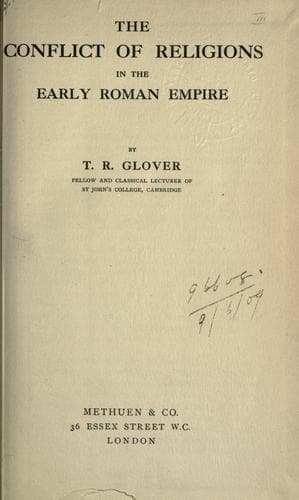
The Conflict of Religions in the Early Roman EmpireGlover, T. R. (Terrot Reaveley)
Religion
The Conflict of Religions in the Early Roman Empire
Glover, T. R. (Terrot Reaveley)
Christianity and other religions; Church history -- Primitive and early church, ca. 30-600; Rome -- Religion
Clement, as already said, professed himself an eclectic in philosophy,
and of such we need not expect the closest reasoning. Our plan will be
to gather passages illustrative of his thoughts--we might almost say of
his moods--and set side by side what he says from time to time of God.
On such a subject it is perhaps impossible to hope for logic or
consistency except at the cost of real aspects of the matter in hand.
Something will be gained if we can realize the thoughts which most
moved the man, even though their reconciliation is questionably
possible. This doubt however does not seem to have occurred to
himself, for he connects the dogmata of the philosophers and the
teaching of the New Testament as if it were the most natural thing in
the world.
{290}
To begin with the account of God which Clement gives in philosophical
language. "The Lord calls himself 'one' (_hen_)--'that they all may be
one ... as we are one; I in them, and thou in me, that they may be
perfected into one.' Now God is 'one' (_hen_) and away beyond the
'one' (_henos_) and above the Monad itself."[105] Again, after quoting
Solon and Empedocles and "John the Apostle" ("no man hath seen God at
any time"), Clement enlarges on the difficulty of speaking of
God:--"How can that be expressed, which is neither genus, nor
differentia, nor species, neither indivisible, nor sum, nor accident,
nor susceptive of accident? Nor could one properly call him a whole
(_holon_); for whole (_to holon_) implies dimension, and he is Father
of the Whole (_ton holon_). Nor could, one speak of his parts, for the
one is indivisible and therefore limitless, not so conceived because
there is no passing beyond it, but as being without dimension or limit,
and therefore without form or name. And if we ever name him, calling
him, though not properly, one, or the good, or mind, or absolute being,
or father, or God, or demiurge, or lord, we do not so speak as putting
forward his name; but, for want of his name, we use beautiful names,
that the mind may not wander at large, but may rest on these. None of
these names, taken singly, informs us of God; but, collectively and
taken all together, they point to his almighty power. For predicates
are spoken either of properties or of relation, and none of these can
we assume about God. Nor is he the subject of the knowledge which
amounts to demonstration; for this depends on premisses (_protera_) and
things better known (_gnorimotepa_);[106] but nothing is anterior to
the unbegotten. It remains then by divine grace and by the Logos alone
that is from him to perceive the unknowable."[107] Again, "God has no
natural relation (_physiken schesin_) to us, as the founders of
heresies hold (not though he make us of what is not, or fashion us from
matter, for _that_ is not at all, and _this_ is in every point
different from God)--unless you venture to say that we are part of him
and of one essence (_homoousious_) with God; and I do not understand
Public-domain text, read in full here on John Shaqi.
Reviews
Reviews
No reviews yet
Be the first to share your thoughts on this work.
Elsewhere in the archive
Join the Discussion
Join the discussion
Sign in to leave a comment or review.
Sign InorCreate an account