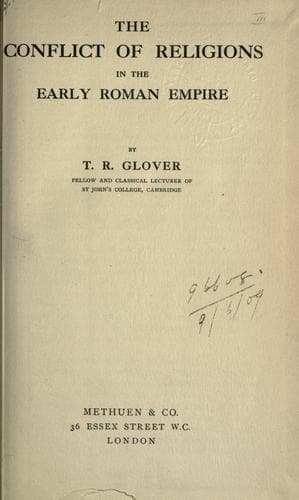
The Conflict of Religions in the Early Roman Empire — John Shaqi
The Conflict of Religions in the Early Roman EmpireGlover, T. R. (Terrot Reaveley)
Religion
The Conflict of Religions in the Early Roman Empire
Glover, T. R. (Terrot Reaveley)
Christianity and other religions; Church history -- Primitive and early church, ca. 30-600; Rome -- Religion
This is no light contribution to an age or to mankind. In this case it
carries with it the whole story that lies before us. Such an
expression of a common instinct gave new force to that instinct; it
added a powerful impulse to the deepest passion that man knows; and, in
spite of the uncertainties which beset the poet himself, it gave new
hope to mankind that the cry of the human heart for God was one that
should receive an answer.
Chapter I Footnotes:
[1] Cic. _ad fam._ x, 16, 2, _Ipse tibi sis senatus_.
[2] _Georgic_ i, 505-514 (Conington's translation, with alterations).
[3] Polybius, vi, 56, Shuckburgh's Translation.
[4] Polybius, xviii, 35.
[5] Sextus Empiricus, _Adv. mathematicos_, ix, 54.
[6] Cicero, _N.D._ i, 42, 118.
[7] Diodorus Siculus, i, 2.
[8] Quoted by Augustine, _C.D._ iv, 27; vi, 5; also referred to by
Tertullian, _ad Natt._ ii, 1.
[9] Suetonius, _Augustus_, 31, 75, 93; Warde Fowler, _Roman Festivals_,
p. 344.
[10] Suet. Aug. 90, 92.
[11] Horace, _Odes_, iii, 24, 9-20, Gladstone's version.
[12] Horace, _Odes_, iii, 6, Delicta maiorum.
[13] _De Haruspicum Responsis_, 9, 19; _N.D._ ii, 3, 8.
[14] E.g. _Apol._ 25, with a serious criticism of the contrast between
Roman character before and after the conquest of the world,--before and
after the invasion of Rome by the images and idols of Etruscans and
Greeks.
[15] _Augustine C.D._ vi, 2.
[16] On _AEneid_, xi, 785.
[17] Propertius, v, 1, 69.
[18] Ovid, _Fasti_, i, 7.
[19] Livy, i, 19.
[20] Livy, iv, 30.
[21] Plutarch, _Romulus_, 21; _Caesar_, 61, Warde Fowler, _Roman
Festivals_, p. 310 f.
[22] Suetonius, _Aug._ 31, Warde Fowler, _op. cit._ p. 190.
[23] Mommsen, _History_, i, p. 231, who translates the hymn.
[24] Quintilian, i, 6, 40. See specimen in Varro, _L.L._ vii, 26.
[25] _Epp._ ii, 1, 20-27, 86.
[26] Cicero, _ad fam._ xiv, 4, 1.
[27] Hor. _Sat._ i, 9, 69: Porphyrion is the authority for the comedies.
[28] Prudentius, _contra Symmachum_, i, 197-218.
[29] Tibullus, i, 10, 15.
[30] _C.D._ iv, 8. "To an early Greek," says Mr Gilbert Murray, "the
earth, water and air were full of living eyes: of _theoi_, of
_daimones_, of _Keres_. One early poet says emphatically that the air
is so crowded full of them that there is no room to put in the spike of
an ear of corn without touching one."--_Rise of Greek Epic_, p. 82.
[31] _de Spect._ 5; cf. _de Idol._ 16; _de cor. mil._ 13, gods of the
door; _de Anima_, 39, goddesses of child-birth.
[32] Lucr. iv, 580 f. Virg. _AEn._ viii, 314.
[33] Cic. _N.D._ ii, 2, 6: cf. _De Div._ i, 45, 101. Warde Fowler,
_Roman Festivals_, pp. 256 ff. on the Fauni.
[34] Pliny, _N.H._ viii, 151; xxx, 84.
[35] Plutarch, _Numa_, 15; _de facie in orbe lunae_, 30; Ovid, _Fasti_,
iii, 291.
[36] Horace's ode attests the power of the Fauns over crops and herds.
[37] Dionys. Hal. v, 16.
[38] Pliny, _N.H._ xii, 3.
Public-domain text, read in full here on John Shaqi.
Reviews
Reviews
No reviews yet
Be the first to share your thoughts on this work.
Join the Discussion
Join the discussion
Sign in to leave a comment or review.
Sign InorCreate an account