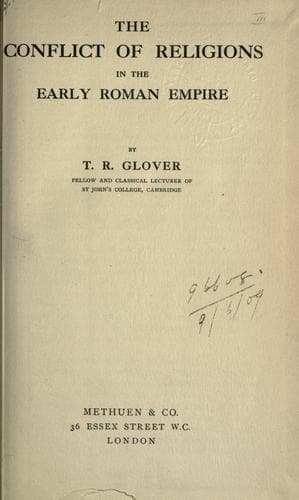
The Conflict of Religions in the Early Roman EmpireGlover, T. R. (Terrot Reaveley)
Religion
The Conflict of Religions in the Early Roman Empire
Glover, T. R. (Terrot Reaveley)
Christianity and other religions; Church history -- Primitive and early church, ca. 30-600; Rome -- Religion
This human greatness, which his poetry brought home to the sympathetic
reader, was not altogether foreign to the thought of the day. _Homo
sacra res homini_[97] was the teaching of the Stoics, but man was a
more sacred thing to the poet than to the philosopher, for what the
philosopher conceived to be a flaw and a weakness in man, the poet
found to be man's chief significance. The Stoic loudly proclaimed man
to be a member of the universe. The poet found man knit to man by a
myriad ties, the strength of which he realized through that pain
against which the Stoic sought to safeguard him. Man revealed to the
poet his inner greatness in the haunting sense of his limitations--he
could not be self-sufficient (_autarkes_) as the Stoic urged; he
depended on men, on women and children, on the beauty of grass and
living creature, of the sea and sky. And even all these things could
not satisfy his craving for love and fellowship; he felt a "hunger for
the infinite." Here perhaps is the greatest contribution of Virgil to
the life of the age.
He, the poet to whom man and the world were most various and meant
most, came to his people, and, without any articulate expression of it
in direct words, made it clear to them that he had felt a gap in the
heart of things, which philosophy could never fill. Philosophy could
remove this sense of incompleteness, but only at the cost of love; and
love was to Virgil, as his poetry shows, the very essence of life. Yet
he gave, and not altogether unconsciously, the impression that in
proportion as love is apprehended, its demands extend beyond the
present. The sixth book of the _AEneid_ settles nothing and proves
nothing, but it expresses an instinct, strong in Virgil, as the result
of experience, that love must reach beyond the grave. Further, the
whole story of AEneas is an utterance of man's craving for God, of the
sense of man's incompleteness without a divine complement. These are
the records of Virgil's life, intensely individual, but not peculiar to
himself. In the literature of his century, there is little indication
of such instincts, but the history of four hundred years shows that
they were deep in the general heart of man.
These impressions Virgil brought before the Roman world. {32} As such
things are, they were a criticism, and they meant a change of values.
In the light of them, the restoration of religion by Augustus became a
little thing; the popular superstition of the day was stamped as vulgar
and trivial in itself, while it became the sign of deep and unsatisfied
craving in the human heart; and lastly the current philosophies, in the
face of Virgil's poetry, were felt to be shallow and cold, talk of the
lip and trick of the brain. Of course this is not just to the
philosophers who did much for the world, and without whom Virgil would
not have been what he was. None the less, it was written in Virgil's
poetry that the religions and philosophies of mankind must be thought
over anew.
Public-domain text, read in full here on John Shaqi.
Reviews
Reviews
No reviews yet
Be the first to share your thoughts on this work.
Join the Discussion
Join the discussion
Sign in to leave a comment or review.
Sign InorCreate an account