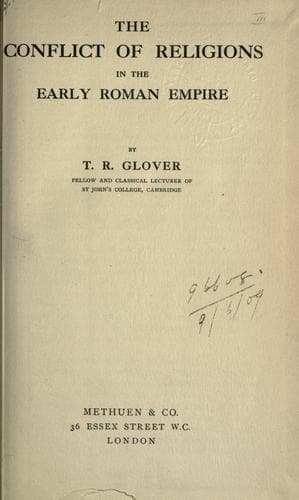
The Conflict of Religions in the Early Roman EmpireGlover, T. R. (Terrot Reaveley)
Religion
The Conflict of Religions in the Early Roman Empire
Glover, T. R. (Terrot Reaveley)
Christianity and other religions; Church history -- Primitive and early church, ca. 30-600; Rome -- Religion
The honour, the property, the life of every Roman lay in the hands of
eunuchs and valets, and, as these quarrelled or made friends, the
fortunes of an old nobility changed with the hour. It had not been so
under Augustus, nor was it so under Vespasian, nor under Trajan or his
successors; but for the greater part of the first century A.D. Rome was
governed by weak or vicious Emperors, and they by their servants. The
spy and the informer were everywhere.
To this confusion fresh elements of uncertainty were added by the
astrologer and mathematician, and it became treason to be interested in
"the health of the prince." Superstition ruled the
weakling--superstition, perpetually re-inforced by fresh hordes of
Orientals, obsequious and unscrupulous. Seneca called the imperial
court, which he knew, "a gloomy slave-gaol" (_triste ergastulum_).[5]
Reduced to merely registering the wishes of their rulers, the Roman
nobility sought their own safety in frivolity and extravagance. To be
thoughtful was to be suspected of independence and to invite danger.
We naturally suppose moralists and satirists to exaggerate the vices of
their contemporaries, but a sober survey of Roman morals in the first
century--at any rate before 70 A.D.--reveals a great deal that {36} is
horrible. (Petronius is not exactly a moralist or a satirist, and
there is plenty of other evidence.) Marriage does not thrive alongside
of terror, nor yet where domestic slavery prevails, and in Rome both
militated against purity of life. The Greek girl's beauty, her charm
and wit, were everywhere available. For amusements, there were the
gladiatorial shows,--brutal, we understand, but their horrible
fascination we fortunately cannot know. The reader of St Augustine's
_Confessions_ will remember a famous passage on these games. The
gladiators were the popular favourites of the day. They toured the
country, they were modelled and painted. Their names survive scratched
by loafers on the walls of Pompeii. The very children played at being
gladiators, Epictetus said--"sometimes athletes, now monomachi, now
trumpeters." The Colosseum had seats for 80,000 spectators of the
games, "and is even now at once the most imposing and the most
characteristic relic of pagan Rome."[6]
[Sidenote: "Despotism tempered by epigrams"]
Public-domain text, read in full here on John Shaqi.
Reviews
Reviews
No reviews yet
Be the first to share your thoughts on this work.
Join the Discussion
Join the discussion
Sign in to leave a comment or review.
Sign InorCreate an account