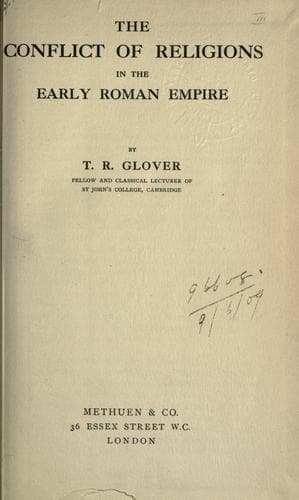
The Conflict of Religions in the Early Roman Empire — John Shaqi
The Conflict of Religions in the Early Roman EmpireGlover, T. R. (Terrot Reaveley)
Religion
The Conflict of Religions in the Early Roman Empire
Glover, T. R. (Terrot Reaveley)
Christianity and other religions; Church history -- Primitive and early church, ca. 30-600; Rome -- Religion
Through all the elaborate pretences devised by Augustus to obscure the
truth, through all the names and phrases and formalities, the Roman
world had realized the central fact of despotism.[2] The Emperors
themselves had grasped it with pride and terror. One at least was
insane, and the position was enough to turn almost any brain.
"Monarchy," in Herodotus' quaint sentence,[3] "would set the best man
outside the ordinary thoughts." Plato's myth of Gyges was
fulfilled--of the shepherd, who found a ring that made him invisible,
and in its strength seduced a queen, murdered a king and became a
tyrant. Gaius banished his own sisters, reminding them that he owned
not only islands but swords; and he bade his grandmother remember that
he could "do anything he liked and do it to anybody."[4] Oriental
princes had been kept at Rome as hostages and had given the
weaker-minded members of the Imperial family new ideas of royalty. The
very word was spoken freely--in his treatise "On Clemency" Seneca uses
again and again the word _regnum_ without apology.
But what gave Despotism its sting was its uncertainty. Augustus had
held a curiously complicated set of special powers severally conferred
on him for specified periods, and technically they could be taken from
him. The Senate was the Emperor's partner in the government of the
world, and it was always conceivable that the partnership might cease,
for it was not a definite institution--prince followed prince, it is
true, but there was an element of accident about it all. The situation
was difficult; Senate and Emperor eyed each other with
suspicion--neither knew how far the other could go, or would go;
neither knew the terms of the partnership. Tiberius wrote despatches
to the Senate and he was an artist in concealing his meaning. The
Senate had to guess what he wished; if it guessed wrong, he would
resent the liberty; if it guessed right, he resented the appearance of
servility. The solitude of the throne grew more and more uneasy.
{35}
Again, the republican government had been in the hands of free men, who
ruled as magistrates, and the imperial government had no means of
replacing them, for one free-born Roman could not take service with
another. The Emperor had to fall back upon his own household. His
Secretaries of State were slaves and freedmen--men very often of great
ability, but their past was against them. If it had not depraved them,
none the less it left upon them a social taint, which nothing could
remove. They were despised by the men who courted them, and they knew
it. It was almost impossible for such men not to be the gangrene of
court and state. And as a fact we find that the freedman was
throughout the readiest agent for all evil that Rome knew, and into the
hands of such men the government of the world drifted. Under a weak,
or a careless, or even an absent, Emperor Rome was governed by such men
and such methods as we suppose to be peculiar to Sultanates and the
East.
Public-domain text, read in full here on John Shaqi.
Reviews
Reviews
No reviews yet
Be the first to share your thoughts on this work.
Join the Discussion
Join the discussion
Sign in to leave a comment or review.
Sign InorCreate an account