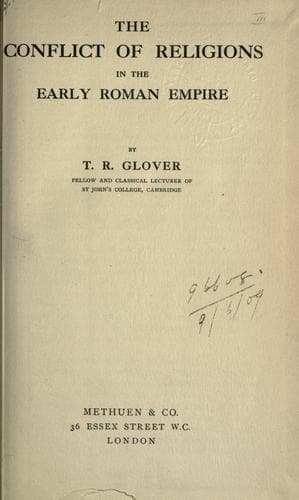
The Conflict of Religions in the Early Roman EmpireGlover, T. R. (Terrot Reaveley)
Religion
The Conflict of Religions in the Early Roman Empire
Glover, T. R. (Terrot Reaveley)
Christianity and other religions; Church history -- Primitive and early church, ca. 30-600; Rome -- Religion
But bitterness and epigram could not heal; and for healing and inward
peace men longed more and more,[11] as they felt their own weakness,
the power of evil and the terror of life; and they found both in a
philosophy that had originally come into being under circumstances
somewhat similar. They needed some foundation for life, some means of
linking the individual to something that could not be shaken, and this
they found in Stoicism. The Stoic philosopher saw a unity in this
world of confusion--it was the "Generative Reason"--the _spermatikos
logos_, the Divine Word, or Reason, that is the seed and vital
principle, whence all things come and in virtue of which they {38}
live. All things came from fiery breath, _pneuma diapuron_, and
returned to it. The whole universe was one polity--_politeia tou
kosmou_--in virtue of the spirit that was its origin and its life, of
the common end to which it tended, of the absolute and universal scope
of the laws it obeyed--mind, matter, God, man, formed one community.
The soul of the individual Roman partook of the very nature of
God--_divinae particula aurae_[12]--and in a way stood nearer to the
divine than did anything else in the world, every detail of which,
however, was some manifestation of the same divine essence. All men
were in truth of one blood, of one family,--all and each, as Seneca
says, sacred to each and all.[13] (_Unum me donavit_ [_sc. Natura
rerum_] _omnibus, uni mihi omnes_.)
[Sidenote: Harmony with nature]
Taught by the Stoic, the troubled Roman looked upon himself at once as
a fragment of divinity,[14] an entity self-conscious and individual,
and as a member of a divine system expressive of one divine idea, which
his individuality subserved. These thoughts gave him ground and
strength. If he seemed to be the slave and plaything of an Emperor or
an imperial freedman, none the less a divine life pulsed within him,
and he was an essential part of "the world." He had two havens of
refuge--the universe and his own soul--both quite beyond the reach of
the oppressor. Over and over we find both notes sounded in the
writings of the Stoics and their followers--God within you and God
without you. "Jupiter is all that you see, and all that lives within
you."[15] There is a Providence that rules human and all other
affairs; nothing happens that is not appointed; and to this Providence
every man is related. "He who has once observed with understanding the
administration of the world, and learnt that the greatest and supreme
and most comprehensive community is the system (_systema_) of men and
God, and that from God come the seeds whence all things, and especially
rational beings, spring, why should not that man call himself a citizen
of the world [Socrates' word _kosmios_], why not a son of God?"[16]
And when we consider the individual, we find that God {39} has put in
his power "the best thing of all, the master thing"--the rational
faculty.
Public-domain text, read in full here on John Shaqi.
Reviews
Reviews
No reviews yet
Be the first to share your thoughts on this work.
Join the Discussion
Join the discussion
Sign in to leave a comment or review.
Sign InorCreate an account