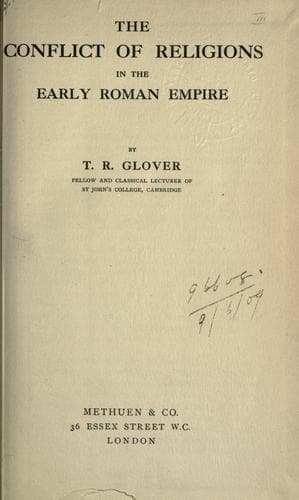
The Conflict of Religions in the Early Roman EmpireGlover, T. R. (Terrot Reaveley)
Religion
The Conflict of Religions in the Early Roman Empire
Glover, T. R. (Terrot Reaveley)
Christianity and other religions; Church history -- Primitive and early church, ca. 30-600; Rome -- Religion
What is not in our power is the entire external world, of
which we can alter nothing, but the use we make of it and its
"appearances"[17] is our own. Confine yourself to "what is in your
power" (_ta epi soi_), and no man can hurt you. If you can no longer
endure life, leave it; but remember in doing so to withdraw quietly,
not at a run; yet, says the sage, "Men! wait for God; when He shall
give you the signal and release you from this service, then go to Him;
but for the present endure to dwell in this place where He has set
you."[18]
To sum up; the end of man's being and his true happiness is what Zeno
expressed as "living harmoniously," a statement which Cleanthes
developed by adding the words "with Nature." Harmony with Nature and
with oneself is the ideal life; and this the outside world of Emperors,
freedmen, bereavements and accidents generally, can neither give nor
take away. "The end," says Diogenes Laertius, "is to act in conformity
with nature, that is, at once with the nature which is in us and with
the nature of the universe, doing nothing forbidden by that common law
which is the right reason that pervades all things, and which is,
indeed, the same in the Divine Being who administers the universal
system of things. Thus the life according to nature is that virtuous
and blessed flow of existence, which is enjoyed only by one who always
acts so as to maintain the harmony between the daemon (_daimon_) within
the individual and the will of the power that orders the universe."[19]
This was indeed a philosophy for men, and it was also congenial to
Roman character, as history had already shown. It appealed to manhood,
and whatever else has to be said of Stoics and Stoicism, it remains the
fact that Stoicism inspired nearly all the great characters of the
early Roman Empire, and nerved almost every attempt that was made to
maintain the freedom and dignity of the human soul.[20] The government
was not slow to realise the danger of men with such a trust in
themselves and so free from fear.
Public-domain text, read in full here on John Shaqi.
Reviews
Reviews
No reviews yet
Be the first to share your thoughts on this work.
Join the Discussion
Join the discussion
Sign in to leave a comment or review.
Sign InorCreate an account