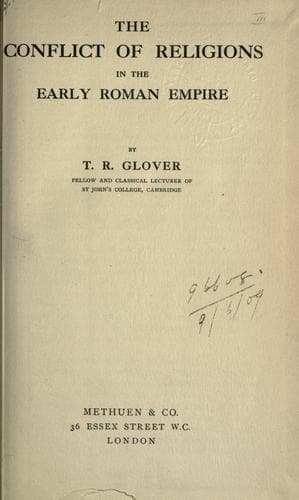
The Conflict of Religions in the Early Roman EmpireGlover, T. R. (Terrot Reaveley)
Religion
The Conflict of Religions in the Early Roman Empire
Glover, T. R. (Terrot Reaveley)
Christianity and other religions; Church history -- Primitive and early church, ca. 30-600; Rome -- Religion
what we call death is transmigration? You don't believe that in beasts
and fishes dwells the mind (_animum_) that was once a man's? ... Great
men have believed it; so maintain your own opinion, but keep the matter
open. If it is true, then to have abstained from animal food will be
innocence; if it is false, it will still be frugality."[23] So for a
year Seneca was a vegetarian with some satisfaction and he fancied that
his mind was livelier than when he was "an eater of beef."[24] It is
as well not to quote some contemporary methods of preparing meat.[25]
However, after a while some scandal arose about foreign religions, and
vegetarianism was counted a "proof of superstition," and the old
rhetorician, more from dislike of philosophy than from fear of calumny,
made it an excuse to put a little pressure on his philosophic son, who
obediently gave up the practice. Such is the ardour of youth, he
concludes,--a good teacher finds idealists ready to his hand. The
fault is partly in the teachers, who train us to argue and not to live,
and partly in the pupils too, whose aim is to have the wits trained and
not the mind. "So what was philosophy becomes philology--the love of
words."[26]
There is a certain gaiety and good humour about these {43} confessions,
which is closely bound up with that air of tolerance and that sense of
buoyant ease[27] which pervade all his work. Here the tone is in
keeping with the matter in hand, but it is not always. Everything
seems so easy to him that the reader begins to doubt him and to wonder
whether he is not after all "The plausiblest Plausible on record." We
associate experience with a style more plain, more tense, more
inevitable; and the extraordinary buoyancy of Seneca's writing suggests
that he can hardly have known the agony and bloody sweat of the true
teacher. Yet under the easy phrases there lay a real sincerity. From
his youth onward he took life seriously, and, so far as is possible for
a man of easy good nature, he was in earnest with himself.
Like other youths of genius, he had had thoughts of suicide, but on
reflexion, he tells us, he decided to live, and his reason was
characteristic. While for himself he felt equal to dying bravely, he
was not so sure that his "kind old father" would be quite so brave in
doing without him. It was to philosophy, he says, that he owed his
resolution.[28]
Public-domain text, read in full here on John Shaqi.
Reviews
Reviews
No reviews yet
Be the first to share your thoughts on this work.
Join the Discussion
Join the discussion
Sign in to leave a comment or review.
Sign InorCreate an account