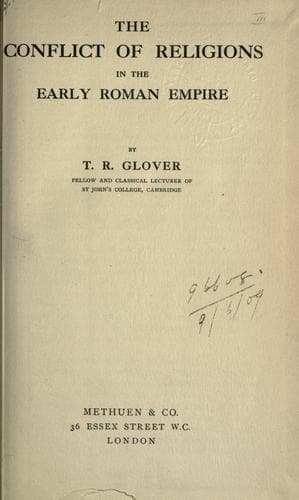
The Conflict of Religions in the Early Roman EmpireGlover, T. R. (Terrot Reaveley)
Religion
The Conflict of Religions in the Early Roman Empire
Glover, T. R. (Terrot Reaveley)
Christianity and other religions; Church history -- Primitive and early church, ca. 30-600; Rome -- Religion
Even in his most one-sided judgments Carlyle is apt to speak truth,
though it is well to remember that he himself said that little is to be
learnt of a man by dwelling only or mainly on his faults. That what he
says in these passages is in some degree true, every candid reader must
admit; but if he had written an essay instead of a paragraph we should
have seen that a great deal more is true of Seneca. As it is, we must
take what Carlyle says as representing a judgment which has often been
passed upon Seneca, though seldom in such picturesque terms. It is in
any case truer than Mommsen's description of Cicero.
[Sidenote: Seneca's early life]
Seneca was born at Cordova in Spain about the Christian era--certainly
not long before it. His father was a rich man of equestrian rank, a
rhetorician, who has left several volumes of rhetorical compositions on
imaginary cases. He hated philosophy, his son tells us.[21] Seneca's
mother seems to have been a good woman, and not the only one in the
family; for his youth was delicate and owed much to the care of a good
aunt at Rome; and his later years were spent with a good wife Pompeia
Paulina, who bore him two little short-lived boys.
In one of his letters (108) Seneca tells us of his early life in Rome.
He went to the lectures of Attalus, a Stoic teacher, who laid great
stress on simplicity of life and independence of character and was also
interested in superstition and soothsaying. The pupil was a
high-minded and sensitive youth, quick then, as he remained through
life, to take fire at an idea.[22] "I used to be the first to come and
the last to go; and as he walked I would lead him on to further
discussions, for he was not only ready for those who would learn, but
he would meet them." "When I heard Attalus declaim against the vices,
errors and evils of life, I would often pity mankind; and as for him I
thought of him as one on high, far above human nature's highest. He
himself used to say he was a king [a Stoic {42} paradox at which Horace
had laughed]; but he seemed to me more than king,--the judge of kings.
When he began to commend poverty, and to show that whatever is more
than need requires, is a useless burden to him that has it, I often
longed to leave the room a poor man. When he attacked our pleasures
and praised the chaste body, the sober table, the pure mind, I
delighted to refrain, not merely from unlawful pleasures, but from
needless ones too. Some of it has stuck by me, Lucilius, for I made a
good beginning." All his life long, in fact, he avoided the luxuries
of table and bath, and drank water. He continues, "Since I have begun
to tell you how much more keenly I began philosophy in my youth than I
persevere with it in my old age, I am not ashamed to own what love of
Pythagoras Sotion waked in me." Sotion recommended vegetarianism on
the grounds which Pythagoras had laid down. "But you do not believe,"
he said, "that souls are allotted to one body after another, and that
Public-domain text, read in full here on John Shaqi.
Reviews
Reviews
No reviews yet
Be the first to share your thoughts on this work.
Join the Discussion
Join the discussion
Sign in to leave a comment or review.
Sign InorCreate an account