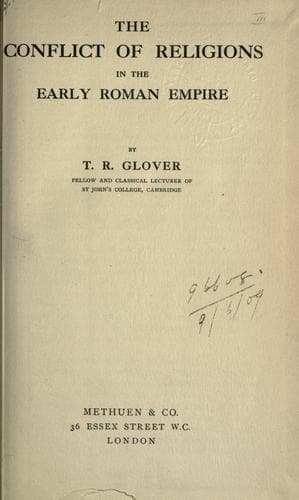
The Conflict of Religions in the Early Roman EmpireGlover, T. R. (Terrot Reaveley)
Religion
The Conflict of Religions in the Early Roman Empire
Glover, T. R. (Terrot Reaveley)
Christianity and other religions; Church history -- Primitive and early church, ca. 30-600; Rome -- Religion
This view of the value of religion is an old one among the Greeks.
Critias, the friend of Socrates, embodied it in verses, which are
preserved for us by Sextus Empiricus. In summary he holds that there
was a time when men's life knew no order, but at last laws were
ordained to punish; and the laws kept men from open misdeeds, "but they
did many things in secret; and then, I think, some shrewd and wise man
invented a terror for the evil in case secretly they should do or say
or think aught. So he introduced the divine, alleging that there is a
divinity (_daimon_), blest with eternal life, who with his mind sees
and hears, thinks, and marks these things, and bears a divine nature,
who will hear all that is said among men and can see all that is done,
and though in silence thou plan some evil, yet this shall not escape
the gods." This was a most pleasant {5} lesson which he introduced,
"with a false reason covering truth"; and he said the gods abode in
that region whence thunder and lightning and rain come, and so "he
quenched lawlessness with laws."[5]
This was a shallow judgement upon religion. That "it utterly abolished
religion altogether" was the criticism of Cicero's Academic.[6] But
most of the contemporary views of the origin of religion were shallow.
Euhemerism with its deified men, and inspiration with its distraught
votaries were perhaps nobler, a little nobler, but in reality there was
little respect for religion among the philosophic. But the practical
people of the day accepted the view of Critias as wise enough. "The
myths that are told of affairs in Hades, though pure invention at
bottom, contribute to make men pious and upright," wrote the Sicilian
Diodorus at this very time.[7] Varro[8] divided religion into three
varieties, mythical, physical (on which the less said in public, he
owned, the better) and "civil," and he pronounced the last the best
adapted for national purposes, as it consisted in knowing what gods
state and citizen should worship and with what rites. "It is the
interest," he said, "of states to be deceived in religion."
So the great question narrowed itself to this:--Was it possible for
another shrewd and wise man to do again for Rome what the original
inventor of religion had done for mankind? once more to establish
effective gods to do the work of police? Augustus endeavoured to show
that it was still possible.
Public-domain text, read in full here on John Shaqi.
Reviews
Reviews
No reviews yet
Be the first to share your thoughts on this work.
Join the Discussion
Join the discussion
Sign in to leave a comment or review.
Sign InorCreate an account