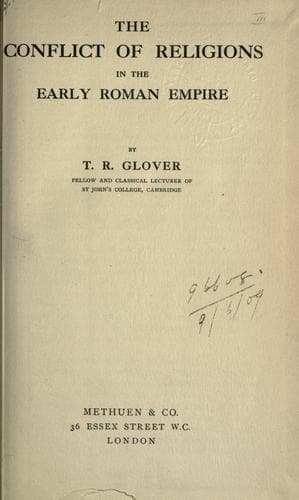
The Conflict of Religions in the Early Roman EmpireGlover, T. R. (Terrot Reaveley)
Religion
The Conflict of Religions in the Early Roman Empire
Glover, T. R. (Terrot Reaveley)
Christianity and other religions; Church history -- Primitive and early church, ca. 30-600; Rome -- Religion
It was not long before an answer was suggested. A reason was found,
which had a history of its own. The decline had been foreseen. We are
fortunately in possession of a forecast by a Greek thinker of the
second century B.C., who knew Rome well--Polybius, the intimate of the
younger Scipio. In the course of his great summary of the Rome he
knew, when he is explaining her actual and future greatness to the
Greek world, he says:--"The most important difference for the better,
which the Roman Commonwealth appears to me to display, is in their
religious beliefs, for I conceive that what in other nations is looked
upon as a reproach, I mean a scrupulous fear of the gods, is the very
thing which keeps the Roman Commonwealth together; (_synechein ta
rhomaion praumata_). To such an extraordinary height is this carried
among them (_ektetragoetai {4} kai pareisektai_) both in private and
public business, that nothing could exceed it. Many people might think
this unaccountable, but in my opinion their object is to use it as a
check upon the common people. If it were possible to form a state
wholly of philosophers, such a custom would perhaps be unnecessary.
But seeing that every multitude is fickle and full of lawless desires,
unreasoning anger and violent passion, the only resource is to keep
them in check by mysterious terrors and scenic effects of this sort
(_tois adelois phobois kai te toiaute tragodia_). Wherefore, to my
mind, the ancients were not acting without purpose or at random, when
they brought in among the vulgar those opinions about the gods and the
belief in the punishments in Hades: much rather do I think that men
nowadays are acting rashly and foolishly in rejecting them. This is
the reason why, apart from anything else, Greek statesmen, if entrusted
with a single talent, though protected by ten checking-clerks, as many
seals and twice as many witnesses, yet cannot be induced to keep faith;
whereas among the Romans, in their magistracies and embassies, men have
the handling of a great amount of money, and yet from pure respect to
their oath keep their faith intact."[3] Later on Polybius limits his
assertion of Roman honesty to "the majority"--the habits and principles
of Rome were beginning to be contaminated.[4]
[Sidenote: The political value of religion]
Public-domain text, read in full here on John Shaqi.
Reviews
Reviews
No reviews yet
Be the first to share your thoughts on this work.
Join the Discussion
Join the discussion
Sign in to leave a comment or review.
Sign InorCreate an account