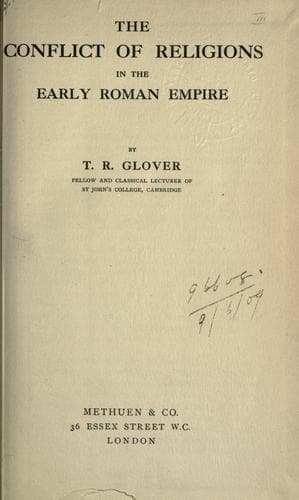
The Conflict of Religions in the Early Roman EmpireGlover, T. R. (Terrot Reaveley)
Religion
The Conflict of Religions in the Early Roman Empire
Glover, T. R. (Terrot Reaveley)
Christianity and other religions; Church history -- Primitive and early church, ca. 30-600; Rome -- Religion
[83] _Ep._ 95, 47-50. Cf. _Ep._ 41; _de Prov._ i, 5. A very close
parallel, with a strong Stoic tinge, in Minucius Felix, 32, 2, 3,
ending _Sic apud nos religiosior est ille qui iustior_.
[84] _Nat. Quaest._ ii, 45. Cf. Tertullian, _Apol._ 21, on Zeno's
testimony to the Logos, as creator, fate, God, _animus Iovis_ and
_necessitas omnium rerum_.
[85] Cf. Sen. _Ep._ 41, 1. Prope est a te deus, tecum est, intus est.
Ita dico, Lucili, sacer intra nos spiritus sedet malorum bonorumque
nostrorum observator et custos.
[86] Epict. D. i, 14. See Clem. Alex. Strom, vii, 37, for an
interesting account of how _phthanei he theia dynamis, kathaper phos
diidein ten phychen_.
[87] _Ep._ 110, 1, paedagogam dari deum.
[88] _D._ iii, 24,
[89] _D._ ii, 14.
[90] _de providentia_, 2, 6-9.
[91] _de Prov._ 4, 1.
[92] _de Prov._ 5, 7. See Justin Martyr's criticism of Stoic fatalism,
_Apol._ ii, 7. It involves, he says, either God's identity with the
world of change, or his implication in all vice, or else that virtue
and vice are nothing--consequences which are alike contrary to every
sane _eeenoia_, to _logos_ and to _nous_.
[93] _de Prov._ 5, 8.
[94] Plutarch, _adv. Stoicos_, 33, on this Stoic paradox of the
equality of God and the sage.
[95] _de Prov._ 6, 5-7. This Stoic justification of suicide was
repudiated alike by Christians and Neo-Platonists.
[96] _D._ i, 1.
[97] _D._ i, 12. See also _D._ ii, 16 "We say 'Lord God! how shall I
not be anxious?' Fool, have you not hands, did not God make them for
you? Sit down now and pray that your nose may not run."
[98] Cf. Cicero's Stoic, _N.D._ ii, 66, 167, _Nemo igitur vir magnus
sine aliquo afflatu divino unquam fuit_.
[99] Ep. 41, 1, 2. (The line is from Virgil, _Aen._ viii, 352.) The
rest of the letter develops the idea of divine dependence. _Sic animus
magnus ac sacer et in hoc demissus at propius quidem divina nossemus,
conversatur quidem nobiscum sed haeret origini suae, etc_.
[100] Ep. 73, 15, 16.
[101] Epictetus, _D._ i, 6.
[102] _D._ i, 9.
[103] _D._ iv, 1.
[104] _D._ iv, 1.
[105] _D._ ii, 16 end, with a variant between _sos eimi_ and _isos
eimi_, the former of which, Long says, is certain.
[106] _D._ i, 16. Contrast the passage of Clement quoted on p. 286.
[107] _D._ ii, 16.
[108] _D._ ii, 16.
[109] _D._ iii, 13.
[110] _D._ ii, 22.
[111] _Ep._ 95, 51-53.
[112] _de ira_, iii, 28, 1.
[113] _Ep._ 95, 33, _homo sacra res homini_.
[114] See Lecky, _European Morals_, i, 294 ff.: Maine, _Ancient Law_,
p. 54 f.
[115] See, by the way, Plutarch's banter on this "polity"--the stars
its tribesmen, the sun, doubtless, councillor, and Hesperus _prytanis_
or _astynomus_, _adv. Sto._ 34.
[116] Epict. _D._ ii, 5; M. Aurelius, viii, 34.
[117] _Ep._ 63, 14.
[118] _D._ iii, 24.
[119] _D._ iv, 1.
[120] _ib._
[121] _D._ iv, 6.
[122] _M._ 16.
Public-domain text, read in full here on John Shaqi.
Reviews
Reviews
No reviews yet
Be the first to share your thoughts on this work.
Elsewhere in the archive
Join the Discussion
Join the discussion
Sign in to leave a comment or review.
Sign InorCreate an account