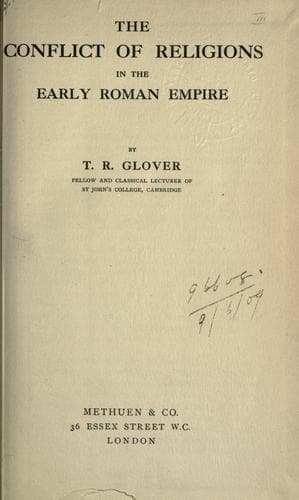
The Conflict of Religions in the Early Roman EmpireGlover, T. R. (Terrot Reaveley)
Religion
The Conflict of Religions in the Early Roman Empire
Glover, T. R. (Terrot Reaveley)
Christianity and other religions; Church history -- Primitive and early church, ca. 30-600; Rome -- Religion
[123] Cf. Theophilus (the apologist of about 160 A.D.), ii, 4, who,
though not always to be trusted as to the Stoics, remarks this
identification of God and conscience.
[124] _D._ i, 29.
[125] Cf. _D._ i, 1; iii, 19; iv, 4; iv, 12, and very many other
passages.
[126] _D._ iv, 9, end.
[127] _Ep._ 31, 5.
[128] Plutarch, _Progress in Virtue_, c. 2, 76 A, on the absurdity of
there being no difference between Plato and Meletus. Cf. also _de
repugn. Stoic._ 11, 1037 D.
[129] "Unconditional eradication," says Zeller, _Eclectics_, p. 226.
"I do not hold with those who hymn the savage and hard Apathy (_ten
agrion kai skleran_)," wrote Plutarch. _Cons, ad Apoll._ 3, 102 C.
See Clem. Alex. _Str._ ii, 110, on _pathe_; as produced by the agency
of spirits, and note his talk of Christian Apathy. _Str._ vi, 71-76.
[130] Justin Martyr (_Apol._ ii, 8) praises Stoic morality and speaks
of Stoics who suffered for it.
[131] Cf. Epict. _D._ iii, 25.
[132] Sen. _Ep._ 50, 4.
[133] Persius, iii, 38.
[134] _Ep._ 6, 1.
[135] e.g. _Ep._ 57, 3, he is not even _homo tolerabilis_. On the
bondage of the soul within the body, see _Ep._ 65, 21-23.
[136] Cf. Seneca, Ep. 53, 7, 8--quo quis peius habet minus sentit.
"The worse one is, the less he notices it."
[137] _D._ i, 5.
[138] Plut. _de repugn. Stoic._ 34, 1050 C. Cf. _Tert. de exh.
castit._ 2.
[139] Cf. Plutarch, _non suaviter_, 1104 F. _kataphronountes eauton os
ephemeron kthe_--of the Epicureans.
[140] Cf. Plutarch, non suaviter, 1104 C. _tes aidiotetus elpis kai ho
pothos tou einai manton epoton prespytatos on kai melstos_. Cf. _ib._
1093 A.
[141] Sen. _Ep._ 117, 6.
[142] _Ep._ 102, 2.
[143] Ep. 102, 21; the following passages are from the same letter.
Note the Stoic significance of _naturale_.
[144] Compare _Cons. ad Marc._ 25, 1, _integer ille, etc._
[145] The last words of the "Consolation." Plutarch on resolution into
_pur noeron_, _non suaviter_, 1107 B.
[146] _ad Polyb._ 9, 3.
[147] _D._ iii, 13. Plutarch (_non suaviter_, 1106 E) says Cocytus,
etc., are not the chief terror but _he tou me ontos apeile_.
[148] _D._ iii, 24.
[149] See Plutarch on this, _non suaviter_, 1105 E.
[150] Seneca, _N.Q._ ii, 45.
[151] Manual, 31. Plutarch, _de repugn. Stoic._ 6, 1034 B, C, remarks
on Stoic inconsistency in accepting popular religious usages.
[152] _D._ ii, 9. In _D._ v, 7, he refers to "Galilaeans," so that it
is quite possible he has Christians in view here.
[153] _M._ 32; _D._ iii, 22.
[154] Plut. _de repugn. Stoic._ 37, 1051 C.
[155] Tertullian, _Apol._ 12, _idem estis qui Senecam aliquem pluribus
et amarioribus de vestra superstitione perorantem reprehendistis_.
[156] See Plutarch, _de comm. not. adv. Stoicos_, c. 31, and _de def.
orac._ 420 A, c. 19; Justin M. _Apol._ ii, 7.
[157] Dial. _c. Tryphone_, 2.
[158] Sen. _Ep._ 11, 8.
[159] _Ep._ 25, 5.
[160] _Ep._ 62, 2, cf. 104, 21.
[161] _M._ 33, _ti nan epoiesen en touto Sokrates he Zenon_.
[162] _M._ 50.
Public-domain text, read in full here on John Shaqi.
Reviews
Reviews
No reviews yet
Be the first to share your thoughts on this work.
Elsewhere in the archive
Join the Discussion
Join the discussion
Sign in to leave a comment or review.
Sign InorCreate an account