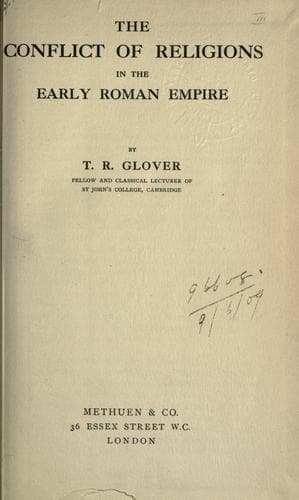
The Conflict of Religions in the Early Roman EmpireGlover, T. R. (Terrot Reaveley)
Religion
The Conflict of Religions in the Early Roman Empire
Glover, T. R. (Terrot Reaveley)
Christianity and other religions; Church history -- Primitive and early church, ca. 30-600; Rome -- Religion
[163] _D._ ii, 18. The tone of Tertullian, _e.g._ in _de Anima_, 1, on
the Phaedo, suggests that Socrates may have been over-preached. What
too (_ib._ 6) of barbarians and their souls, who have no "prison of
Socrates," etc?
[164] Plut. _de Stoic. repugnantiis_, 31, 1048 E. Cf. _de comm. not._
33.
[165] Plutarch, _Amat._ 13, 757 C. _horas depou ton upolambanonta
buthon hemas atheotetos, an eis pathe kai dynameis kai aretas
diagraphomen ekaston ton theon_.
{75}
CHAPTER III
PLUTARCH
Stoicism as a system did not capture the ancient world, and even upon
individuals it did not retain an undivided hold. To pronounce with its
admirers to-day that it failed because the world was not worthy of it,
would be a judgment, neither quite false nor altogether true, but at
best not very illuminative. Men are said to be slow in taking in new
thoughts, and yet it is equally true that somewhere in nearly every man
there is something that responds to ideas, and even to theories; but if
these on longer acquaintance fail to harmonize with the deeper
instincts within him, they alarm and annoy, and the response comes in
the form of re-action.
In modern times, we have seen the mind of a great people surrendered
for a while to theorists and idealists. The thinking part of the
French nation was carried away by the inspiration of Rousseau into all
sorts of experiments at putting into hasty operation the principles and
ideas they had more or less learnt from the master. Even theories
extemporized on the moment, it was hoped, might be made the foundations
of a new and ideal social fabric. The absurdities of the old religion
yielded place to Reason--embodied symbolically for the hour in the
person of Mme Momoro--afterwards, more vaguely, in Robespierre's
Supreme Being, who really came from Rousseau. And then--"avec ton Etre
Supreme tu commences a m'embeter," said Billaud to Robespierre himself.
Within a generation Chateaubriand, de Maistre, Bonald, and de la
Mennais were busy refounding the Christian faith. "The rites of
Christianity," wrote Chateaubriand, "are in the highest degree moral,
if for no other reason than that they have been practised by our
fathers, that our mothers have watched over our cradles as Christian
women, that the Christian religion has chanted its psalms over our
parents' coffins and invoked peace upon them in their graves."
{76}
Alongside of this let us set a sentence or two of Plutarch. "Our
father then, addressing Pemptides by name, said, 'You seem to me,
Pemptides, to be handling a very big matter and a risky one--or rather,
you are discussing what should not be discussed at all (_ta akineta
kinein_), when you question the opinion we hold about the gods, and ask
reason and demonstration for everything. For the ancient and ancestral
faith is enough (_arkei gar he patrios kai palaia pistis_), and no
clearer proof could be found than itself--
Not though man's wisdom scale the heights of thought--
Public-domain text, read in full here on John Shaqi.
Reviews
Reviews
No reviews yet
Be the first to share your thoughts on this work.
Elsewhere in the archive
Join the Discussion
Join the discussion
Sign in to leave a comment or review.
Sign InorCreate an account