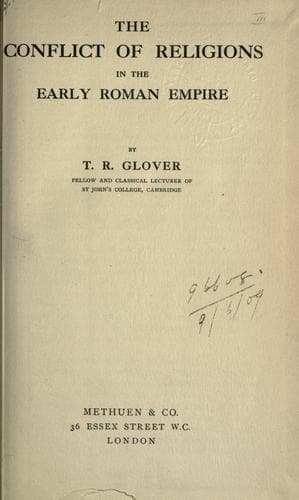
The Conflict of Religions in the Early Roman EmpireGlover, T. R. (Terrot Reaveley)
Religion
The Conflict of Religions in the Early Roman Empire
Glover, T. R. (Terrot Reaveley)
Christianity and other religions; Church history -- Primitive and early church, ca. 30-600; Rome -- Religion
but it is a common home and an established foundation for all piety;
and if in one point its stable and traditional character (_to bebainon
autes kai nenomismenon_) be shaken and disturbed, it will be undermined
and no one will trust it.... If you demand proof about each of the
ancient gods, laying hands on everything sacred and bringing your
sophistry to play on every altar, you will leave nothing free from
quibble and cross-examination (_ouden asykophanteton oud
abasaniston_).... Others will say that Aphrodite is desire and Hermes
reason, the Muses crafts and Athene thought. Do you see, then, the
abyss of atheism that lies at our feet, if we resolve each of the gods
into a passion or a force or a virtue?'"[1]
Such an utterance is unmistakeable--it means a conservative re-action,
and in another place we find its justification in religious emotion.
"Nothing gives us more joy than what we see and do ourselves in divine
service, when we carry the emblems, or join in the sacred dance, or
stand by at the sacrifice or initiation.... It is when the soul most
believes and perceives that the god is present, that she most puts from
her pain and fear and anxiety, and gives herself up to joy, yes, even
as far as intoxication and laughter and merriment.... In sacred
processions and sacrifices not only the old man and the old woman, nor
the poor and lowly, but
The thick-legged drudge that sways her at the mill,
and household slaves and hirelings are uplifted by joy and triumph.
Rich men and kings have always their own banquets and feasts--but the
feasts in the temples and at initiations, when men seem to touch the
divine most nearly in their thought, {77} with honour and worship, have
a pleasure and a charm far more exceeding. And in this no man shares
who has renounced belief in Providence. For it is not abundance of
wine, nor the roasting of meat, that gives the joy in the festivals,
but also a good hope, and a belief that the god is present and
gracious, and accepts what is being done with a friendly mind."[2]
[Sidenote: Continuity of religion]
One of Chateaubriand's critics says that his plea could be advanced on
behalf of any religion; and Plutarch had already made it on behalf of
his own. He looks past the Stoics, and he finds in memory and
association arguments that outweigh anything they can say. The
Spermaticos Logos was a mere Etre Supreme--a sublime conception
perhaps, but it had no appeal to emotion, it waked no memories, it
touched no chord of personal association. We live so largely by
instinct, memory and association, that anything that threatens them
seems to strike at our life,
So was it when my life began;
So is it now I am a man;
So be it when I shall grow old,
Or let me die!
The Child is father of the Man;
And I could wish my days to be
Bound each to each by natural piety.
Public-domain text, read in full here on John Shaqi.
Reviews
Reviews
No reviews yet
Be the first to share your thoughts on this work.
Elsewhere in the archive
Join the Discussion
Join the discussion
Sign in to leave a comment or review.
Sign InorCreate an account