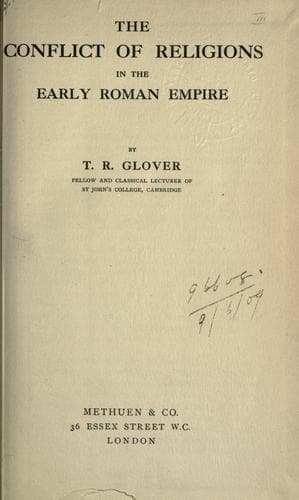
The Conflict of Religions in the Early Roman EmpireGlover, T. R. (Terrot Reaveley)
Religion
The Conflict of Religions in the Early Roman Empire
Glover, T. R. (Terrot Reaveley)
Christianity and other religions; Church history -- Primitive and early church, ca. 30-600; Rome -- Religion
But this is not all, for in his letter written to console Apollonios
Plutarch carries us further. There was, he says, a {99} man who lost
his only son--he was afraid, by poison. It perhaps adds confidence to
the story that Plutarch gives his name and home; he was Elysios of
Terina in Southern Italy. The precision is characteristic. Elysios
accordingly went to a _psychomanteion_, a shrine where the souls of the
dead might be consulted.[86] He duly sacrificed and went to sleep in
the temple. He saw in a dream his own father with a youth strikingly
like the dead son, and he was told that this was "the son's daemon,"[87]
and that the death had been natural, and right for the lad and for his
parents. Elsewhere Plutarch quotes the lines of Menander--
By each man standeth, from his natal hour,
A daemon, his kind mystagogue through life--[88]
but he prefers the view of Empedocles that there are two such beings in
attendance on each of us.[89] The classical instance of a guardian
spirit was the "daimonion" of Socrates, on which both Plutarch and
Apuleius wrote books.[90] Plutarch discusses many theories that had
been given of it, but hardly convinces the reader that he really knew
what Socrates meant.
In a later generation it was held that if proper means were taken the
guardian spirit would come visibly before a man's eyes. So Apuleius
held, and Porphyry records that when an Egyptian priest called on the
daemon of Plotinus to manifest himself in the temple of Isis (the only
"pure" spot the Egyptian {100} could find in Rome), there came not a
daemon but a god; so great a being was Plotinus.[91] Plutarch discusses
the question of such bodily appearances in connexion with the legend of
Numa and Egeria. He can believe that God would not disdain the society
of a specially good and holy man, but as for the idea that god or daemon
would have anything to do with a human body--"that would indeed require
some persuasion." "Yet the Egyptians plausibly say that it is not
impossible for the spirit of a god to have intercourse with a woman and
beget some beginnings of life," though Plutarch finds a difficulty in
such a union of unequals.[92]
Plutarch has comparatively little to say of visible appearances of
tutelary or other daemons. To what lengths of credulity men went in
this direction will be shown in a later chapter. Yet a guardian who
does not communicate in some way with the person he guards, and a
series of daemonic and divine powers content to be inert and silent,
would be futile; and in fact there was, Plutarch held, abundance of
communication between men and the powers above them. It was indeed one
of the main factors of his religion that man's life is intimately
related to the divine.
Public-domain text, read in full here on John Shaqi.
Reviews
Reviews
No reviews yet
Be the first to share your thoughts on this work.
Elsewhere in the archive
Join the Discussion
Join the discussion
Sign in to leave a comment or review.
Sign InorCreate an account