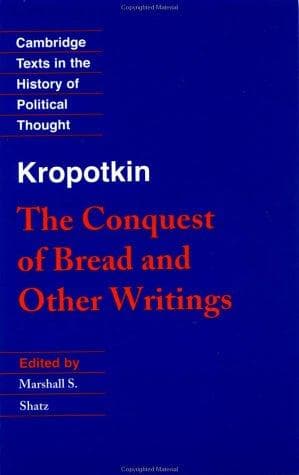
The Conquest of BreadKropotkin, Petr Alekseevich, kniaz
Philosophy
The Conquest of Bread
Kropotkin, Petr Alekseevich, kniaz
Anarchism; Communism
The mines, though they represent the labour of several generations, and
derive their sole value from the requirements of the industry of a
nation and the density of the population--the mines also belong to the
few; and these few restrict the output of coal, or prevent it entirely,
if they find more profitable investments for their capital. Machinery,
too, has become the exclusive property of the few, and even when a
machine incontestably represents the improvements added to the original
rough invention by three or four generations of workers, it none the
less belongs to a few owners. And if the descendants of the very
inventor who constructed the first machine for lace-making, a century
ago, were to present themselves to-day in a lace factory at Bâle or
Nottingham, and claim their rights, they would be told: "Hands off! this
machine is not yours," and they would be shot down if they attempted to
take possession of it.
The railways, which would be useless as so much old iron without the
teeming population of Europe, its industry, its commerce, and its marts,
belong to a few shareholders, ignorant perhaps of the whereabouts of
the lines of rails which yield them revenues greater than those of
medieval kings. And if the children of those who perished by thousands
while excavating the railway cuttings and tunnels were to assemble one
day, crowding in their rags and hunger, to demand bread from the
shareholders, they would be met with bayonets and grapeshot, to disperse
them and safeguard "vested interests."
In virtue of this monstrous system, the son of the worker, on entering
life, finds no field which he may till, no machine which he may tend, no
mine in which he may dig, without accepting to leave a great part of
what he will produce to a master. He must sell his labour for a scant
and uncertain wage. His father and his grandfather have toiled to drain
this field, to build this mill, to perfect this machine. They gave to
the work the full measure of their strength, and what more could they
give? But their heir comes into the world poorer than the lowest savage.
If he obtains leave to till the fields, it is on condition of
surrendering a quarter of the produce to his master, and another quarter
to the government and the middlemen. And this tax, levied upon him by
the State, the capitalist, the lord of the manor, and the middleman, is
always increasing; it rarely leaves him the power to improve his system
of culture. If he turns to industry, he is allowed to work--though not
always even that--only on condition that he yield a half or two-thirds
of the product to him whom the land recognizes as the owner of the
machine.
Public-domain text, read in full here on John Shaqi.
Reviews
Reviews
No reviews yet
Be the first to share your thoughts on this work.
Join the Discussion
Join the discussion
Sign in to leave a comment or review.
Sign InorCreate an account