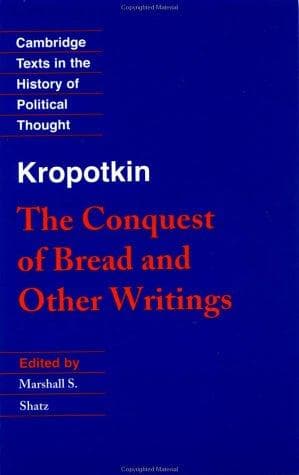
The Conquest of BreadKropotkin, Petr Alekseevich, kniaz
Philosophy
The Conquest of Bread
Kropotkin, Petr Alekseevich, kniaz
Anarchism; Communism
We cry shame on the feudal baron who forbade the peasant to turn a clod
of earth unless he surrendered to his lord a fourth of his crop. We
called those the barbarous times. But if the forms have changed, the
relations have remained the same, and the worker is forced, under the
name of free contract, to accept feudal obligations. For, turn where he
will, he can find no better conditions. Everything has become private
property, and he must accept, or die of hunger.
The result of this state of things is that all our production tends in a
wrong direction. Enterprise takes no thought for the needs of the
community. Its only aim is to increase the gains of the speculator.
Hence the constant fluctuations of trade, the periodical industrial
crises, each of which throws scores of thousands of workers on the
streets.
The working people cannot purchase with their wages the wealth which
they have produced, and industry seeks foreign markets among the monied
classes of other nations. In the East, in Africa, everywhere, in Egypt,
Tonkin or the Congo, the European is thus bound to promote the growth of
serfdom. And so he does. But soon he finds that everywhere there are
similar competitors. All the nations evolve on the same lines, and wars,
perpetual wars, break out for the right of precedence in the market.
Wars for the possession of the East, wars for the empire of the sea,
wars to impose duties on imports and to dictate conditions to
neighbouring states; wars against those "blacks" who revolt! The roar of
the cannon never ceases in the world, whole races are massacred, the
states of Europe spend a third of their budgets in armaments; and we
know how heavily these taxes fall on the workers.
Education still remains the privilege of a small minority, for it is
idle to talk of education when the workman's child is forced, at the age
of thirteen, to go down into the mine or to help his father on the farm.
It is idle to talk of studying to the worker, who comes home in the
evening wearied by excessive toil, and its brutalizing atmosphere.
Society is thus bound to remain divided into two hostile camps, and in
such conditions freedom is a vain word. The Radical begins by demanding
a greater extension of political rights, but he soon sees that the
breath of liberty leads to the uplifting of the proletariat, and then he
turns round, changes his opinions, and reverts to repressive legislation
and government by the sword.
A vast array of courts, judges, executioners, policemen, and gaolers is
needed to uphold these privileges; and this array gives rise in its turn
to a whole system of espionage, of false witness, of spies, of threats
and corruption.
Public-domain text, read in full here on John Shaqi.
Reviews
Reviews
No reviews yet
Be the first to share your thoughts on this work.
Join the Discussion
Join the discussion
Sign in to leave a comment or review.
Sign InorCreate an account