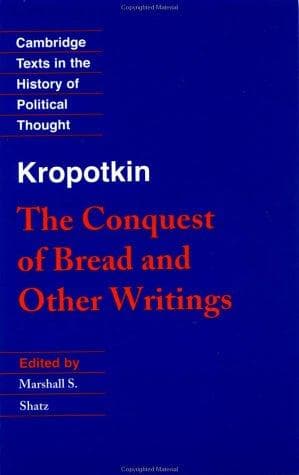
The Conquest of BreadKropotkin, Petr Alekseevich, kniaz
Philosophy
The Conquest of Bread
Kropotkin, Petr Alekseevich, kniaz
Anarchism; Communism
This is the secret of wealth: find the starving and destitute, pay them
half a crown, and make them produce five shillings worth in the day,
amass a fortune by these means, and then increase it by some lucky
speculation, made with the help of the State.
Need we go on to speak of small fortunes attributed by the economists to
forethought and frugality, when we know that mere saving in itself
brings in nothing, so long as the pence saved are not used to exploit
the famishing?
Take a shoemaker, for instance. Grant that his work is well paid, that
he has plenty of custom, and that by dint of strict frugality he
contrives to lay by from eighteen pence to two shillings a day, perhaps
two pounds a month.
Grant that our shoemaker is never ill, that he does not half starve
himself, in spite of his passion for economy; that he does not marry or
that he has no children; that he does not die of consumption; suppose
anything and everything you please!
Well, at the age of fifty he will not have scraped together £800; and
he will not have enough to live on during his old age, when he is past
work. Assuredly this is not how fortunes are made. But suppose our
shoemaker, as soon as he has laid by a few pence, thriftily conveys them
to the savings bank and that the savings bank lends them to the
capitalist who is just about to "employ labour," i.e., to exploit the
poor. Then our shoemaker takes an apprentice, the child of some poor
wretch, who will think himself lucky if in five years' time his son has
learned the trade and is able to earn his living.
Meanwhile our shoemaker does not lose by him, and if trade is brisk he
soon takes a second, and then a third apprentice. By and by he will take
two or three working men--poor wretches, thankful to receive half a
crown a day for work that is worth five shillings, and if our shoemaker
is "in luck," that is to say, if he is keen enough and mean enough, his
working men and apprentices will bring him in nearly one pound a day,
over and above the product of his own toil. He can then enlarge his
business. He will gradually become rich, and no longer have any need to
stint himself in the necessaries of life. He will leave a snug little
fortune to his son.
That is what people call "being economical and having frugal, temperate
habits." At bottom it is nothing more nor less than grinding the face of
the poor.
Commerce seems an exception to this rule. "Such a man," we are told,
"buys tea in China, brings it to France, and realizes a profit of thirty
per cent. on his original outlay. He has exploited nobody."
Public-domain text, read in full here on John Shaqi.
Reviews
Reviews
No reviews yet
Be the first to share your thoughts on this work.
Join the Discussion
Join the discussion
Sign in to leave a comment or review.
Sign InorCreate an account