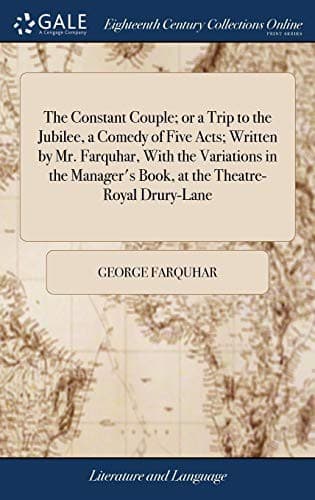
The Constant Couple; Or, A Trip to the Jubilee: A Comedy, in Five ActsFarquhar, George
General
The Constant Couple; Or, A Trip to the Jubilee: A Comedy, in Five Acts
Farquhar, George
Comedy plays; English drama (Comedy)
_Clinch. jun._ Then you shall certainly be hanged; but confess that you
killed him, and we'll let you go.
_Tom._ Telling the truth hangs a man, but confessing a lie can do no
harm: besides, if the worst come to the worst, I can but deny it
again.--Well, sir, since I must tell you, I did kill him.
_Clinch. jun._ Here's your money, sir.--But are you sure you killed him
dead?
_Tom._ Sir, I'll swear it before any judge in England.
_Dicky._ But are you sure that he's dead in law?
_Tom._ Dead in law! I can't tell whether he be dead in law. But he's as
dead as a door nail; for I gave him seven knocks on the head with a
hammer.
_Dicky._ Then you have the estate by statute. Any man that's knocked on
the head is dead in law.
_Clinch. jun._ But are you sure he was compos mentis when he was killed?
_Tom._ I suppose he was, sir; for he told me nothing to the contrary
afterwards.
_Clinch. jun._ Hey! Then I go to the Jubilee.--Strip, sir, strip. By
Jupiter Ammon, strip.
_Dicky._ Ah! don't swear, sir. [_Puts on his Brother's Clothes._
_Clinch. jun._ Swear, sir! Zoons, ha'n't I got the estate, sir? Come,
sir, now I'm in mourning for my brother.
_Tom._ I hope you'll let me go now, sir.
_Clinch. jun._ Yes, yes, sir; but you must do the favour to swear
positively before a magistrate, that you killed him dead, that I may
enter upon the estate without any trouble. By Jupiter Ammon, all my
religion's gone, since I put on these fine clothes.--Hey, call me a
coach somebody.
_Tom._ Ay, master, let me go, and I'll call one immediately.
_Clinch. jun._ No, no; Dicky, carry this spark before a justice, and
when he has made oath, you may discharge him. And I'll go see Angelica.
[_Exeunt_ DICKY _and_ TOM.] Now that I'm an elder brother, I'll court,
and swear, and rant and rake, and go to the Jubilee with the best of
them. [_Exit._
SCENE II.
LADY LUREWELL'S _House_.
_Enter_ LADY LUREWELL _and_ PARLY.
_Lure._ Are you sure that Vizard had my letter?
_Parly._ Yes, yes, madam; one of your ladyship's footmen gave it to him
in the Park, and he told the bearer, with all transports of joy, that he
would be punctual to a minute.
_Lady L._ Thus most villains some time or other are punctual to their
ruin; Are all things prepared for his reception?
_Parly._ Exactly to your ladyship's order: the alderman too is just
come, dressed and cooked up for iniquity.
_Lady L._ Then he has got woman's clothes on?
_Parly._ Yes, madam, and has passed upon the family for your nurse.
_Lady L._ Convey him into that closet, and put out the candles, and tell
him, I'll wait on him presently. When he is tired of his situation, let
the servants pretend they take him for a common rogue, come with the
intent to rob the house, and pump him heartily.
[_As_ PARLY _goes to put out the Candles, somebody knocks.--Music plays
without._
_Lady L._ This must be Sir Harry; tell him I am not to be spoken with.
Public-domain text, read in full here on John Shaqi.
Reviews
Reviews
No reviews yet
Be the first to share your thoughts on this work.
Join the Discussion
Join the discussion
Sign in to leave a comment or review.
Sign InorCreate an account