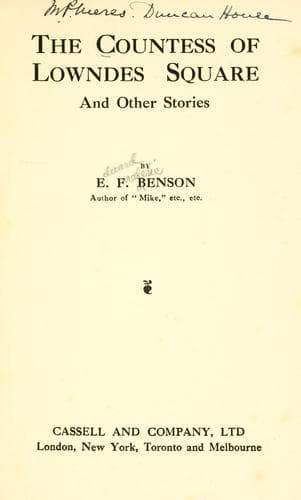
The Countess of Lowndes Square, and Other StoriesBenson, E. F. (Edward Frederic)
General
The Countess of Lowndes Square, and Other Stories
Benson, E. F. (Edward Frederic)
English fiction -- 20th century; Short stories, English
“What a delightful name!” she said. “I’m sure Miss Ainslie must be a
delightful old lady with ringlets and a vinaigrette and a
mourning-brooch.”
“I haven’t seen her for years,” said Colonel Ascot. “I will tell you
about her when we meet again. Do let it be soon!”
“Perhaps you would drop in for tea to-day?” she suggested, expunging
from her mind several other engagements. “I shall be alone.”
“That will make up for my curtailed luncheon-party,” said he.
He made his excuses to his guests, and after allowing him a liberal time
in which he could leave the house, Lady Hampshire rose also.
“You are not going yet, dear Cynthia?” asked the Duchess. “I wanted to
talk to you about the advantage of doing your shopping at Mason’s. And
the danger of it,” she added, catching Lady Hampshire’s kind
understanding eye.
Lady Hampshire felt torn between conflicting interests. Here, she
unerringly conjectured, there was fish to fry for Agatha, and yet other
fish, so to speak, who perhaps wanted to fry. Agatha demanded a more
immediate attention.
The duchess’s complication must wait: she was dining with her to-morrow.
Colonel Ascot was going to see Agatha: nothing must prevent Lady
Hampshire from hearing what his business was.
She went across the Square, and let herself into her own house. There
were half a dozen telegrams lying on the hall table, but without
dreaming of opening any, she went straight to her bedroom and locked the
door. Someone--probably the second footman--was being funny at the
servants’ dinner, for shrieks of laughter ascended from the basement. As
a rule, she loved to know that her household was enjoying itself, but
to-day that merriment left her cold, and next moment she was in Agatha’s
house and pursing her lips into the shrill whistle with which she always
summoned Magsby.
“I left a note addressed to M. S.,” she said; “I want it.”
The words were yet in her mouth, when the bell of Agatha’s front door
rang in an imperious manner, and Lady Hampshire peeped cautiously out
through the yellow muslin blinds. On the doorstep was standing an old,
old man with a long white beard. He leaned heavily on a stick, and wore
a frayed overcoat.
She tip-toed back from the window.
“Give me the note,” she said, “and wait till I get upstairs. Then answer
the door, and tell Methuselah that Miss Ainslie will be down in a
moment.”
Lady Hampshire stole up to Agatha’s room, and hastily assumed her grey
wig, her spectacles, her rouge, her large elastic-sided boots, her
lip-salve, her creaking alpaca gown, and with the envelope containing
bank-notes for £250, addressed in Agatha’s dramatic sloping handwriting
to the messenger of M. S., descended again to her sitting-room.
Methuselah rose as she entered, and she made him her ordinary prim
Agatha bow, and spoke in Miss Ainslie’s husky treble voice.
“The messenger of M. S.,” she observed. “Quite so.”
“That is my name for the present,” said the old man in a fruity tenor.
Public-domain text, read in full here on John Shaqi.
Reviews
Reviews
No reviews yet
Be the first to share your thoughts on this work.
Join the Discussion
Join the discussion
Sign in to leave a comment or review.
Sign InorCreate an account