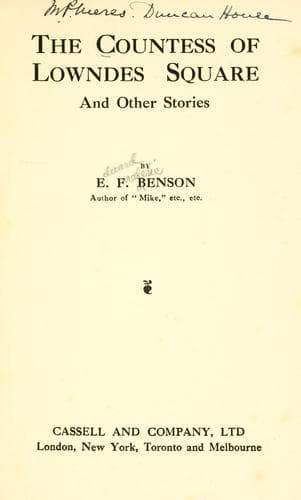
The Countess of Lowndes Square, and Other StoriesBenson, E. F. (Edward Frederic)
General
The Countess of Lowndes Square, and Other Stories
Benson, E. F. (Edward Frederic)
English fiction -- 20th century; Short stories, English
“Practically every afternoon. I always find I have forgotten something I
meant to buy the day before. Also, it is a sort of retreat. One never
meets there anybody one knows, which is such a rest. I don’t have to
grin and talk.”
Lunch was soon over, and instead of having coffee and cigarettes served
at the table, Colonel Ascot got up.
“I do hope, Lady Hampshire,” he said, “that you and the others will not
hurry away, and that you will excuse me, as I have a most important
engagement at a quarter-past three, which I cannot miss. It is very
annoying, and the worst of it is that I made the appointment myself,
quite forgetting that I was to have the pleasure of seeing you at
lunch.”
“Am I to take your place as hostess?” she asked, as she sat down with
him for a moment in a corner of the drawing-room.
“If you will, both now and always,” said he.
She laughed; he had proposed to her so often that a repetition was not
in the least embarrassing. But somehow, to-day, he looked unusually
attractive and handsome, and she was more serious with him than was her
wont. Also the thought of doing business for Agatha was in her mind.
“Ah, my dear friend,” she said, “I should have to know so much more
about you first. For instance, that appointment of your own making seems
to me to need inquiry. Now be truthful, Colonel Ascot, and tell me if
it is not a woman you are going to see?”
“Well, it is.”
“I knew it,” she said.
“But you must let me tell you more,” said he. “She is an old governess
of my sister’s, whom I--I want to be kind to. Such a good old soul. The
sort of helpless old lady with whom one couldn’t break an appointment
that one had made.”
Lady Hampshire laughed again.
“Your details are admirable,” she said. “And detail is of such prime
importance in any artistic production.”
“Artistic production?” said he. “Surely you don’t suspect me of----”
“I suspect everybody of everything,” she interrupted lightly, “owing to
my extensive knowledge of myself. But go on; I want more details. What
is the name and address of this helpless old governess?”
“Miss Agatha Ainslie,” said he. “She lives in Whitstaple Street, just
off the Square.”
Lady Hampshire had nerves of steel. If they had been of any other
material they must have snapped like the strings of the lyre of Hope in
Mr. Watts’s picture. Only in this case there would not have been a
single one left. Colonel Ascot going to see Agatha at a quarter-past
three.... How on earth did he know of Agatha’s existence? What was
Agatha to him, or he to Agatha? And surely it was at a quarter-past
three that the messenger of the ruthless M. S. was going to call at
Whitstaple Street, where he would find the packet of bank-notes for £250
that Lady Hampshire had made ready before she came out to lunch. Would
they meet on the doorstep? What did it all mean?
Her head whirled, but she managed to command her voice.
Public-domain text, read in full here on John Shaqi.
Reviews
Reviews
No reviews yet
Be the first to share your thoughts on this work.
Join the Discussion
Join the discussion
Sign in to leave a comment or review.
Sign InorCreate an account