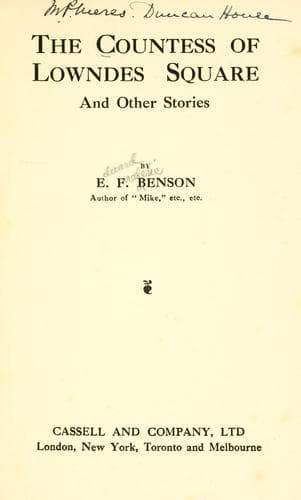
The Countess of Lowndes Square, and Other StoriesBenson, E. F. (Edward Frederic)
General
The Countess of Lowndes Square, and Other Stories
Benson, E. F. (Edward Frederic)
English fiction -- 20th century; Short stories, English
Magsby, waiting in the passage outside, felt uncertain as to what her
duty was. She heard her mistress’s voice and the voice of another,
shrieking with laughter, which seemed to gather volume and enjoyment the
longer it went on. Eventually she thought best to retreat to the
basement and prepare haddocks for dinner.
* * * * *
“But, my dear, let us be serious,” said Lady Hampshire at length. “Tell
me, before I begin to laugh again, how on earth you ever heard of my
poor Agatha!”
“A mutual client,” said Colonel Ascot, fanning himself with his long
white beard. “Poor Jimmy Dennison. He told me, in a fit of natural
exasperation, when I was reminding him about what happened at Brighton
last September, that he could not afford to pay for the same thing twice
over, once to me, and once to Agatha Ainslie. The poor boy showed me the
counterfoils of his cheque-book. It was Agatha Ainslie and Martin
Sampson all the way. It was but natural, since he could not pay, that I
should turn to Agatha and see if she could.”
“But are you really one of us?” said Lady Hampshire.
“Apparently. Are you?”
There was a fresh relapse of laughter, and then Lady Hampshire pulled
herself together.
“I will go halves in Jimmy Dennison,” she said, “whatever we may get.
You may say you have squared Agatha. He ought to give you something for
your trouble. Or I will say I have squared Sampson.”
“It makes no difference,” said Colonel Ascot. “But I am afraid our
interests conflict in many quarters. For instance, the poor Duchess of
Camber.”
“Shopping at Mason’s,” interrupted Lady Hampshire. “My dear friend, she
is mine. She was going to tell me all about it this afternoon, only I
had to come over here to see about Agatha.”
Again Colonel Ascot exploded with laughter.
“But she told me about it yesterday,” he said, “and I had already
drafted a short letter to her from Martin Sampson.”
Lady Hampshire was annoyed at this, since the Duchess was so very rich
and so very silly.
“I don’t know what we can do,” she said; “we can’t appoint an
arbitrator, can we? No arbitrator of really high character would
undertake to settle the differences of two blackmailers. It is very
important that an arbitrator should be beyond suspicion.”
“We had really better make it one firm, Cynthia,” said he.
She had often considered his proposal before, but never so favourably.
Agatha need not be annihilated now; Agatha would probably grow even more
tumultuously alive.
“Yes, perhaps we had,” she said. “Oh, yes, most decidedly!”
So they lived happily and wealthily and amazingly for another
twenty-four years--there is much yet that might be said about them.
THE BLACKMAILER OF PARK LANE
Public-domain text, read in full here on John Shaqi.
Reviews
Reviews
No reviews yet
Be the first to share your thoughts on this work.
Join the Discussion
Join the discussion
Sign in to leave a comment or review.
Sign InorCreate an account