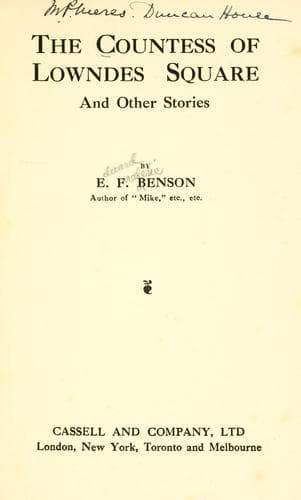
The Countess of Lowndes Square, and Other StoriesBenson, E. F. (Edward Frederic)
General
The Countess of Lowndes Square, and Other Stories
Benson, E. F. (Edward Frederic)
English fiction -- 20th century; Short stories, English
Arthur Whately had known very well what it was like to be desperately
poor, and in consequence, when he became so desperately rich that money
ceased to mean anything to him, his pity for the penurious was not
hysterical or exaggerated. He could recall very vividly what it felt
like to have neither tea, dinner nor supper, and to wake in the morning,
stiff and cold as armour, on a bench on the Embankment and see the
ridiculous needle of Cleopatra stonily pointing heavenwards against the
sky, in which the stars were beginning to burn dim at the chilly
approach of day. He had known how icy the feet become when they have
been close clasped all night long in the frayed embraces of gaping
leather, but he had known also how sweet and surprising it is to eat
when food is imperiously demanded by the cravings of long-continued
abstinence, and how ineffably luxurious to get warm when limbs have
ached themselves numb. He would have been willing to confess that
unveneered destitution had its inconveniences, but it was false
sentiment to deny that it had its compensations also.
It was when he was just sixteen that Luck, the great veiled goddess whom
all the world so wisely worships, had paid him her first visit. He had
been hanging about at the covered portico of the Lyceum Theatre one
night watching the well-fed world being lumpily deposited at the doors,
when a silly old pink gentleman, in paying his cabman, dropped a
promising pocket-book in the roadway. For one half-second the boy
deliberated, wondering instinctively (though he had never heard of the
proverb) if honesty was the best policy, in other words, how much the
pocket-book contained, and how much the foolish old gentleman would give
him if he picked it up and returned it. A couple of pence, perhaps, for
he looked a coppery gent.
But the debate lasted scarcely longer than it took the pocket-book to
fall; in a moment his wise decision was made, he had picked it up
(recognizing in that delightful incident the smile of the great
goddess), had dived under the Roman nose of the cab horse, and fled into
the street where a chill, unpleasant rain was falling. Luck still smiled
on him, for the night was foggy, and as soon as he had crossed the
street he dropped into the habitual shuffling pace of the homeless, and
returned to the portico which he had so lately quitted, since it was
theoretically impossible that the thief should do anything so foolish.
The silly old pink gentleman had not yet ceased to gesticulate and
jibber in the direction in which he himself had just vanished, and an
obsequious policeman was apparently taking down all the bad words he
used in a neat notebook. Arthur wondered if he would arrest the old man
for indulging in language redolent of faint praise in a public place.
Public-domain text, read in full here on John Shaqi.
Reviews
Reviews
No reviews yet
Be the first to share your thoughts on this work.
Join the Discussion
Join the discussion
Sign in to leave a comment or review.
Sign InorCreate an account