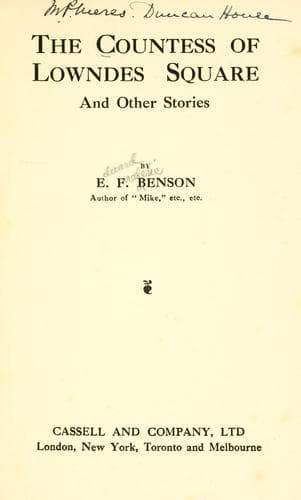
The Countess of Lowndes Square, and Other StoriesBenson, E. F. (Edward Frederic)
General
The Countess of Lowndes Square, and Other Stories
Benson, E. F. (Edward Frederic)
English fiction -- 20th century; Short stories, English
The fan-room overlooked the Park, and regardless of possible
interpretations Arthur Whately had straw permanently put down in the
roadway to deaden the noise of traffic. There had been a ruffle with the
vestry on the subject of this straw. Men with pitchforks came and took
it up. But as often as they took it up he had it renewed, and by now it
had become as much a feature of Park Lane as the omnibuses. Occasionally
a policeman, new to the beat and fired by professional enthusiasm, would
question the straw-strewers, but the mystic whisper, “A friend of Mr.
Whately’s,” had the forcefulness and wit of brevity about it.
The game was tepid; not even his opponent’s remarkable and reiterated
revoke in no-trumps really warmed it, and Arthur Whately was glad when
his guests departed, for, unaccustomed as he was to brooding over
imaginary troubles or dulling his very acute brain with the narcotic
poisoning of self-analysis, he was a little anxious about himself
to-night, and was glad of a quiet hour before going to bed to examine
the cause of his disquietude. It was still early when they left, for
there was a dance somewhere to which the two ladies with the
irrepressible enthusiasm of advanced middle-age were going on, while the
financier was going home. On the doorstep he confided to his host that
his name was to appear next morning among the peerages given in honour
of the King’s Birthday, and Arthur Whately supposed he was going to seek
the privacy of his own study to practise writing his new name, which was
to be Peebles, in memory of pleasure.
He adjusted the bell-pealing apparatus in the fan-room, and retired to
his own sitting-room, which adjoined his bedroom. Half a dozen exquisite
Watteaus decorated the walls, and the bureau which stood opposite the
door was from the effects of the unfortunate Queen of France. Often and
often he had thrilled at the thought that she had sat there and written
those little ill-spelled notes in her sprawling hand, but to-night he
would not have cared if he had found her sitting there in person.
_Tædium vitæ_, the weariness, the boredom of success, which poisons the
lives of emperors and scratch golfers, had laid its heavy hand on him.
He had poached the world like an egg. But he could find no salt....
So it was that which ailed him. Often of late he had found he had little
zest for this pursuit or that, but it had not struck him till this
moment that the whole affair was flat. And yet it was not himself, so he
felt, that was to blame. He was still but a year or two past fifty,
handsome and healthy, and his powers of enjoyment he knew were undimmed,
provided only he could find something to exercise them on. In himself he
was eager, alert, longing for excitement, but to do the same thing over
and over again did not excite him; the early years of hunger and
struggle and achievement had accustomed him to a high level of emotion.
He wanted to burn, not to smoulder quietly away, as most people were
content to do.
Public-domain text, read in full here on John Shaqi.
Reviews
Reviews
No reviews yet
Be the first to share your thoughts on this work.
Join the Discussion
Join the discussion
Sign in to leave a comment or review.
Sign InorCreate an account