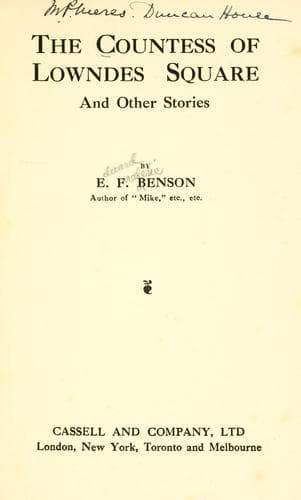
The Countess of Lowndes Square, and Other StoriesBenson, E. F. (Edward Frederic)
General
The Countess of Lowndes Square, and Other Stories
Benson, E. F. (Edward Frederic)
English fiction -- 20th century; Short stories, English
Indeed, he had done everything he could think of. He had loved and
married, and been bored, and had no intention of tempting the _ennui_ of
domesticity again. Nor had he any tastes for the more irregular
pleasures of the senses; they were all poached and saltless. Material
possessions, of course, had ceased to interest him, since he was
completely surrounded with all that he thought most exquisite in the
world of art, and to accumulate for the mere sake of accumulation seemed
to him an exhibition of pig-trough greed. And it was so easy; he could
buy anything that was for sale. Perhaps if Mr. Morgan or some insatiable
hoarder owned a desirable piece or picture and would not part with it at
any price, he might find a secret rapture in attempting to steal it,
just as his wife had done with the fans, but otherwise the act of
acquisition had become too easy to be any longer agreeable.
Everything wanted salt, but that was the fault of the objective world.
He, subjectively, had as good an appetite as on the entranced and
canonized evening when he stole the pocket-book of the silly pink man,
that unconscious founder of his fortunes, who, vastly sillier than ever,
had dined with him only last week, and had had a fatal apoplectic
seizure immediately afterwards.
To-night he almost cursed his memory for his foolishness thirty-five
years ago, for it was that theft which had led to this weariness. If
only the poor pink departed had caught him and given him a taste of
gaol, Arthur Whately felt that he might now be rapturously pursuing the
thrilling hazardous paths of the hardened criminal, to whom every house
is a possible crib to be cracked, every jewel in a woman’s necklace a
week of delirium and drunken debauch. But where is the fun of stealing
if you already own more than you can possibly want?
In his mind he swiftly ran through the ten commandments, and found, as
he had feared, that it would not give him the slightest pleasure to
break any of them. There might be a little excitement about bearing
false witness against your neighbour, but then that would entail
appearing in a law court and listening to the pitiful humour of some
fussy judge. As for the rest of the commandments, they suggested nothing
amusing. There was nothing to be done with the fifth, because his father
and mother had been dead for years; the sixth implied blood and
violence, and violence was foreign to his nature. But for a moment he
lingered over the picture of strangling Lord Peebles and burying him in
the straw in Park Lane. There was something grotesquely attractive in
the notion, but probably the coroner’s jury would give their verdict
that he had been strangled by natural causes, and that death had been
accelerated by the immediate prospect of a peerage.
Public-domain text, read in full here on John Shaqi.
Reviews
Reviews
No reviews yet
Be the first to share your thoughts on this work.
Join the Discussion
Join the discussion
Sign in to leave a comment or review.
Sign InorCreate an account