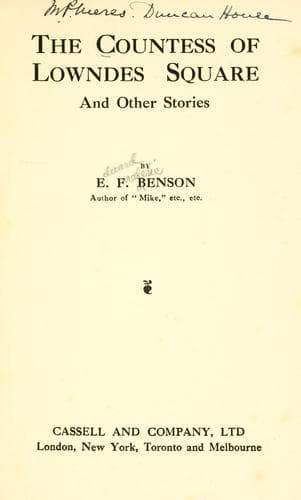
The Countess of Lowndes Square, and Other StoriesBenson, E. F. (Edward Frederic)
General
The Countess of Lowndes Square, and Other Stories
Benson, E. F. (Edward Frederic)
English fiction -- 20th century; Short stories, English
He lunched out that day. His soul basked in the heaven of high animal
spirits which had so long been lost to him, and in the stimulus which
the last week had brought to him he felt like a peri who had regained
Paradise. Perhaps reaction would come, but for the present it held
aloof, and in case it did he could always, as he phrased it to himself
as he walked lightly down Bond Street, apply the squeezers again to poor
Peebles. The vocabulary as well as the spirits of a schoolboy had come
back to him; long-forgotten slang tripped off his tongue, and he
examined shop-windows with eager enthusiasm. There was a beautiful
Charles II. rat-tail spoon in a shop of old silver, and he entered and
bought it, paying for it on the spot with fifteen of his newly acquired
sovereigns. The purchase gave him more pleasure than any he had made for
years: it was the fruit of his splendid stroke of blackmail.
At another shop he bought for five pounds a charming figure of a seagull
in Copenhagen china. Lord Peebles had a collection of this pale fabric,
and his friend felt it would be a privilege to add to it. That also was
paid for in gold, and after he had left each shop a quiet man entered
and conferred privately with the proprietor, leaving a companion
outside, who strolled after the millionaire.
Returning home, he sent out a number of invitations for a dinner party
in ten days’ time. A royal princess had intimated that she would like to
dine with him that night, and he included in his invitations Lord and
Lady Peebles, both of whom were snobs of “purest ray serene.” Later on
he would ask them again to some similar function, for he felt that two
such invitations would make full compensation for the anxiety he had
caused. He did not regard the bagatelle of gold; that meant nothing to
either of them. Then after an hour with his beautiful collection of
Greek coins he dressed and went out to dinner.
Lord Peebles was of the party, and the two cut into a table of bridge
afterwards, and played for a couple of hours, with luck distinctly
against the newly created peer. Generally his losses caused him
exquisite agony: being very rich, he could not bear to be ever so little
poorer. But to-night he laid down a couple of ten-pound notes with a
smile.
“I pay you, my dear Whately,” he said, “fourteen pounds, is it not? I
wonder if you can give me six.”
Whately could and did.
“You have had the worst of luck,” he observed genially, “but it’s only a
game. By the way, I hope I shall see you and your wife to dinner on the
23rd. I sent you an invitation this evening.”
Lord Peebles took up his change and looked rather carefully at each
sovereign in turn, as if to question its genuineness.
“Curious thing,” he said, “each of these sovereigns is marked. There is
a small capital ‘P’ scratched on the field in front of St. George.”
Public-domain text, read in full here on John Shaqi.
Reviews
Reviews
No reviews yet
Be the first to share your thoughts on this work.
Join the Discussion
Join the discussion
Sign in to leave a comment or review.
Sign InorCreate an account