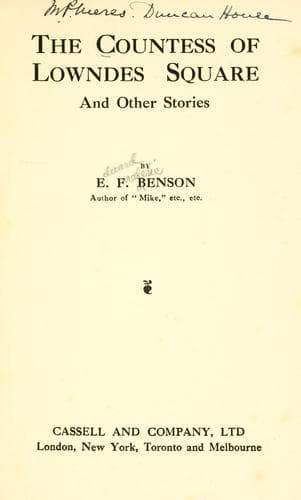
The Countess of Lowndes Square, and Other StoriesBenson, E. F. (Edward Frederic)
General
The Countess of Lowndes Square, and Other Stories
Benson, E. F. (Edward Frederic)
English fiction -- 20th century; Short stories, English
He passed one over to Whately, who felt as if some warning whistle had
sounded remotely in his ears. But he contrived to speak in his natural
voice, and got up.
“I see,” he said; “I wonder what that means. Bates gave me them just
before I came out.”
“Indeed,” said Lord Peebles negligently. “Yes, the 23rd would be
delightful. Are you going?”
“Yes, I think I shall be off,” said Whately.
He drove back to Park Lane, and without setting the pleasant peal of
electric bells in the fan-room, went straight to his bedchamber and got
out the box which had thrilled him with such exquisite pangs of pleasure
that morning. He stripped the paper off sausage after sausage of gold,
until his bed was piled with the precious metal. And on each shining
disc the same ominous discovery met his eye: just in front of St.
George’s head on every one that he took up was scratched a small capital
“P.”
* * * * *
He slept far from well that night, for his mind, spinning madly like a
whirling top, came into collision with a series of hard angles of
uncomfortable circumstances. He told himself that it was inconceivable
that his friend should have suspected him of the odious crime of
blackmailing, but his friend evidently when paying the ransom had taken
steps to trace its destination, with a view to the apprehension of the
criminal. By a most strange coincidence it was he, Arthur Whately, who
had supplied him with a clue, though he had had the presence of mind to
say that Bates had given him these six pieces of evidence.... Then with
a pang of alarm that made him sit bolt upright in bed, he remembered
that there were four more of them in the shop where they sold china cats
and seagulls, fifteen more in the silversmith’s, where he had bought the
Charles II. spoon, and two others in the hair-cutting establishment in
St. James’s Street, where he had so lightly purchased a safety-razor
and a small indiarubber sponge. At all costs he must repossess himself
of these, and how was that to be done? In this short summer night there
was scarcely time, even if he had had the tools, to make a series of
single-handed burglaries, yet if he did not get those accursed
sovereigns back, he was letting the tap of evidence drip and drip and
drip. What, again, was the use of those nineteen hundred and odd
sovereigns on his bed if he could not put them in circulation without
multiplying the evidence already in existence? The suspense of the last
week, it is true, had been thrilling and delicious, but it appeared now
that there were at least two sorts of suspense, and the other, though
quite as thrilling, was not so pleasant. Sinking into an uneasy slumber,
he dreamed of skilly.
Haggard and unshaven (in spite of the new safety-razor), he was in Bond
Street next morning early, with cheque-book and bank-notes in his
pocket. The shop that dealt in old silver was only just open, and he
went hurriedly in.
Public-domain text, read in full here on John Shaqi.
Reviews
Reviews
No reviews yet
Be the first to share your thoughts on this work.
Join the Discussion
Join the discussion
Sign in to leave a comment or review.
Sign InorCreate an account