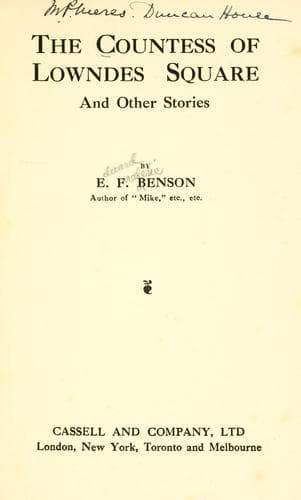
The Countess of Lowndes Square, and Other Stories — John Shaqi
The Countess of Lowndes Square, and Other StoriesBenson, E. F. (Edward Frederic)
General
The Countess of Lowndes Square, and Other Stories
Benson, E. F. (Edward Frederic)
English fiction -- 20th century; Short stories, English
Her father, the notorious (probably infamous) Baron Kakao, of mixed and
uncertain origin, had at one time compiled by hook or crook (chiefly, it
is to be feared, by crook) an immense fortune; but long after that was
spent, and debts of an equally substantial nature been substituted for
it, he continued to live in London in a blaze of splendour so Oriental,
that he was still believed to be possessed of fabulous wealth, and had
without the least difficulty married the plain but fascinating Cynthia
to an elderly Earl of Hampshire, and had continued to allow her £10,000
a year, which he borrowed at a staggering rate of usury from optimistic
Hebrews. They thought that Lord Hampshire would probably see to his
father-in-law’s debts; while, rather humorously, Lord Hampshire was
post-obiting himself with others who trusted that Baron Kakao would
come to the rescue of his son-in-law.
Consequently, when he and Cynthia’s disgusting husband expired within a
few hours of each other, the widowed and orphaned Countess was left
without a penny in the world, and in Rama was there a voice heard,
lamentation and great mourning! Father and husband were both sad rogues,
and in death, in more than a chronological sense, it is highly probable
that they were not divided.
It will therefore be easily imagined that her childhood and marriage had
been a sound and liberal education to Lady Hampshire; for they had
taught her that the world in general is very easily imposed upon, and
that if you are intending to be a villain, the path of villainy is made
much smoother to the pilgrim if he smiles. Shakespeare perhaps had given
her the germ of that invaluable truth; but, as in countless other
instances, her brilliant brain brought to full flower what was only an
immature bud of knowledge. In any case, the villain, so she shrewdly
reasoned, must keep his frown to himself, and however dreadful the
machinations on which he is employed, must cultivate a dewy _bonhomie_
in public, and pretend to be innocently engrossed in the pleasures and
palaces of this delightful world. Lady Hampshire went farther than this
(especially since she had taken to sour milk), and actually was
engrossed in them for a large majority of the hours of those entrancing
summer days. But, like all game fish, she had a close time, which
occurred every morning over her post. For to let the reader into her
terrible and unsuspected secret, she was an earnest and adroit
blackmailer.
It is easy to find excuses (if excuses are needed) to account for her
adoption of so vivid and thrilling a life, for indeed it is difficult to
see how she could have existed at all without some such source of income
as this, and still less could she have kept up her delightful house in
Lowndes Square, her cottage in the Cotswolds, her luxurious and rapid
motor-car, her box at the opera, her wonderful toilettes at Sandown and
Epsom, and Newmarket and Aix and Marienbad.
Public-domain text, read in full here on John Shaqi.
Reviews
Reviews
No reviews yet
Be the first to share your thoughts on this work.
Join the Discussion
Join the discussion
Sign in to leave a comment or review.
Sign InorCreate an account