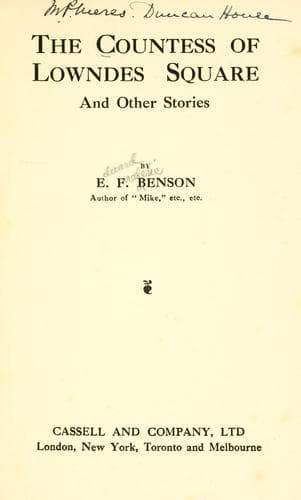
The Countess of Lowndes Square, and Other StoriesBenson, E. F. (Edward Frederic)
General
The Countess of Lowndes Square, and Other Stories
Benson, E. F. (Edward Frederic)
English fiction -- 20th century; Short stories, English
All these simple pleasures were really a necessity of life to her, while
in addition to that she rightly regarded them as an indispensable part
of her “makeup” as a blackmailer, a mask behind which she could securely
grin. Had she, with her historic name, gone to live in Whitechapel or
Bayswater, people would have inevitably concluded that she was hard up,
and in the charitable manner characteristic of the world, have wondered
how she managed to live at all except by some course of secret and
remunerative crime. Whereas the genial and affluent Countess who gave
her box at the opera, not to her friend (for she was too clever for
that), but to her possible enemies, whenever she did not want it (which
was six nights in the week, since she detested music as much as she
detested detectives), was a woman who need not laugh at suspicion,
simply because there were no suspicions to laugh at. Nobody bothered
himself or herself as to how she got her money, just because she always
spent it so delightfully. If she had not spent it thus, or if there had
been none to spend, there would have been excellent cause for the world
to wonder where it came (or did not come) from.
A word is necessary for the sake of those few who may possibly be
ignorant of how such things are pleasantly managed, as to her methods
when in pursuit of her profession. From an amateur standpoint, and to
the world at large, she was, as has been said, Cynthia, Countess of
Hampshire; but in her business capacity and to the scarcely less
numerous world of her trembling clients she was Agatha Ainslie (Miss).
Here she differed from Shakespeare, for she held that there was a great
deal in a name, and (apart from the obvious objections to trading as
Cynthia Hampshire) there was in the sound of “Agatha Ainslie” much which
would inspire a misplaced confidence. Agatha Ainslie, to anyone entering
into business relations with her for the first time, would seem to be a
not unkindly blackmailer; she might suitably have lived in a cathedral
close, with her sister. There was something wistful and pathetic about
the title: it was in no way sharkish. She sounded gentle, though her
immediate mission might appear diabolical; she was a pleasant dentist
who might be supposed to treat you to nasty jabs and vivid extractions
for your permanent good.
In Lady Hampshire’s life, passed as it was in country-houses and
restaurants and Continental spas, it was no wonder that she found many
clients. There was scarcely a scandal in London that did not reach her
sympathetic ear before it became public, and there were certainly many
scandals that reached that eager orifice which never became public at
all. She had a memory which bordered on the Gladstonian for
retentiveness, and a terrifying and menacing pen, and a few words
dropped secretly into her ear came out of Agatha’s stylograph with
blistering effect.
Public-domain text, read in full here on John Shaqi.
Reviews
Reviews
No reviews yet
Be the first to share your thoughts on this work.
Join the Discussion
Join the discussion
Sign in to leave a comment or review.
Sign InorCreate an account