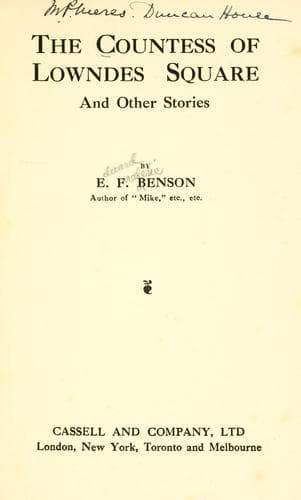
The Countess of Lowndes Square, and Other StoriesBenson, E. F. (Edward Frederic)
General
The Countess of Lowndes Square, and Other Stories
Benson, E. F. (Edward Frederic)
English fiction -- 20th century; Short stories, English
But the salient point on which every psychologist’s eye was pensive
to-day was why she had dismissed Seraphina after a year’s harmonious
co-operation for agreeing with Salvatore that a particular beefsteak did
not stink. Never had she had such a servant as Seraphina, nor ever
would, and well she knew it. Someone suggested that Mrs. Mackellar had
determined to be an eater of uncooked foods, and others who remembered
her welter of appreciation over an ordinary mutton cutlet, hardly
troubled to reply to so inadmissible a conjecture. As we whittled away
at her, the point of the discussion grew ever sharper, for why had she
so clearly smiled in answer to Seraphina’s greeting just now? The idea
that the smile was purely sardonic had most supporters: one or two who
kindly upheld the view that she was meaning to make it up with Seraphina
were hissed down. The most obdurate alone stuck to it, and had the
hardihood to bet five liras that this was the true explanation of the
smile, and the readiness with which he found takers for that bet, caused
him to experience an access of prudence, and to explain that he only
meant to bet five liras all told, and not fifty. Alas!
No one was walking in my direction, and some half an hour later I went
slowly home. Already I was beginning to regret that I had not taken more
of those bets, for the shrewdest analyst of motive and psychology in
Alatri had been bound to confess that Mrs. Mackellar’s motives, like the
path of the comets that should, according to all calculations,
periodically destroy the earth, were, when all was said and done,
completely unconjecturable. No application of logic, or reason, of the
movements of heavy bodies seemed to apply to them, and for that very
reason I had rejected the sardonic nature of that smile for Seraphina,
and in the spirit of “Credo, quia impossible” had taken it for a smile
of reconciliation. But I stood to win five liras, and who would quarrel
with so enviable a conclusion, especially since it implied the
re-installation of Seraphina? That was not a wholly altruistic
consideration, for Leonard had said in so many words that Mrs. Mackellar
would probably attempt to seduce Francesco away from my service with the
lure of higher wages. That was a horrible thought, and I quickened my
steps as I came near to my villa.
I heard bounding footsteps coming down the outside stairs from the front
door into the garden, which could only be Francesco’s, and I wondered
whether he was prancing towards me in order to communicate his wonderful
good luck in going as cook to Mrs. Mackellar, at twice the wages he at
present received. I believed Mrs. Mackellar, like the prophet Habakkuk,
to be “_capable de tout_,” but I didn’t really believe this infamy of
Francesco. The garden door flew open, and he met me with a face of
mourning.
Public-domain text, read in full here on John Shaqi.
Reviews
Reviews
No reviews yet
Be the first to share your thoughts on this work.
Join the Discussion
Join the discussion
Sign in to leave a comment or review.
Sign InorCreate an account