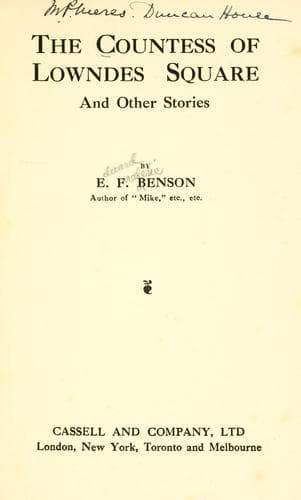
The Countess of Lowndes Square, and Other StoriesBenson, E. F. (Edward Frederic)
General
The Countess of Lowndes Square, and Other Stories
Benson, E. F. (Edward Frederic)
English fiction -- 20th century; Short stories, English
But with the innate kindliness of her nature, she never allowed Agatha
to blackmail any who could not afford to pay, and she had several times
deferred the exaction of her little fines until it was certain that her
client would not be seriously embarrassed and possibly driven to the
desperate course of denouncing her. Never had she had reason to blame
herself for a suicide, and she had Sir Andrew Clarke’s authority for
believing that no one ever died of sleeplessness. She only milked the
fat, sleek cows, and twisted the tails of the bulky bulls. Indeed, as
she quaintly said to herself, she looked upon the payments they made as
a sort of insurance against indiscretions on their part in the future.
She protected them against their own lower instincts.
Her arrangements for Agatha were thoughtful in the extreme. Years ago
her father had owned a small house in Whitstaple Street, of the kind
described in auctioneering circles as “bijou,” which backed on to her
own less jewel-sized mansion in Lowndes Square. This house in Whitstaple
Street had providentially escaped the notice of his creditors when his
affairs--if an entire absence of assets can be considered affairs--were
wound up, and in order to give Miss Ainslie a discreet and convenient
home, it had only been necessary to cut a door through the back of a big
closet in her bedroom in Lowndes Square. The rates and taxes of the
bijou were punctually paid by Agatha, who had, of course, a separate
banking-account and a curious sloping hand, while a secret and terrible
old woman called Magsby, whom Lady Hampshire could ruin on the spot for
forging a valueless cheque of her father’s, opened the door to the
clients, and made gruesome haddocky meals for herself in the kitchen.
Upstairs Lady Hampshire kept her Agatha-clothes, in which she looked
like some unnatural cross between a hospital nurse and the sort of
person who gets more stared at than talked to, and when she had found a
home for the guileless young carpenter who fashioned her means of
communication between Lowndes Square and Whitstaple Street in a remote
though salubrious district of Western Australia, it really seemed as if
she might laugh at the idea of detectives. She had but to lock herself
into her bedroom, and in five minutes Agatha, with her spectacles and
rouge and terrible wig, would be firmly conversing with clients in
Whitstaple Street. Then, when a pleasant conclusion had been come to,
five minutes more would be sufficient, and Lady Hampshire would emerge
from her bedroom refreshed by her rest, and ready to immerse herself in
a perfect spate of fashionable diversions.
Such to Lady Hampshire’s effusive and optimistic mind was her career as
it should have been. But occasionally the hard sordid facts of existence
“put spokes” in the wheel that should have whirled so merrily. And as
she sat this morning in her elaborate dressing-gown, she found a spoke
of the most obstructive kind.
Public-domain text, read in full here on John Shaqi.
Reviews
Reviews
No reviews yet
Be the first to share your thoughts on this work.
Join the Discussion
Join the discussion
Sign in to leave a comment or review.
Sign InorCreate an account