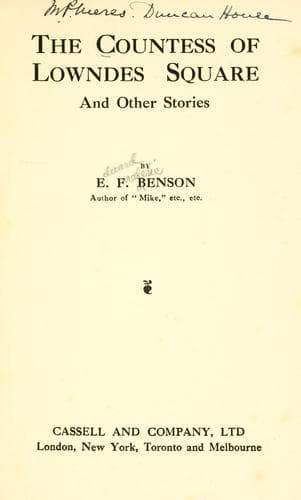
The Countess of Lowndes Square, and Other StoriesBenson, E. F. (Edward Frederic)
General
The Countess of Lowndes Square, and Other Stories
Benson, E. F. (Edward Frederic)
English fiction -- 20th century; Short stories, English
Lady Hampshire had several other clients to write to, and it was time
(when she had finished this correspondence, and put it through the
secret door at the back of her bedroom closet to be collected and posted
by grim Magsby) to exchange her dressing-gown for the habiliments of
lunch and civilization. A new costume had come for her from Paquin’s
that morning, and as she was to go to two charity bazaars, a matinée,
and as many tea-parties as there was time for between the end of the
matinée and the early dinner which was to precede another theatre and a
couple of balls, she decided to wear this sumptuous creation.
Anything new, provided the point of it was not to be old, put this
mercurial lady into excellent humour, and she set out for lunch, which
was only just across the square, not more than half an hour late,
looking, as the representative of a fashion-paper who was standing at
the corner on the chance of seeing her told her readers the following
Saturday, “very smart and well-gowned.” She knew she was certain to meet
friends, since that always happened; and by the time she took her seat
next her host, finding lunch already half-over, she had quite dismissed
from her mind the trouble of poor Miss Ainslie.
“But how delicious to see food again,” she said as she sat down. “I was
so afraid lunch-time was never coming that I didn’t recognize it when it
came.”
“And we were afraid that you were never coming, dear Cynthia,” said the
Duchess of Camber.
“I know; I am late. But as I always am late, it is the same as if I was
punctual. The really unpunctual people are those who sometimes are late
and sometimes not. Colonel Ascot has the other punctuality; he is always
in time.”
Cynthia looked round the table. There were but half a dozen guests, but
all these were old friends, and by a not uncommon coincidence half of
them were clients of Agatha, while the Duchess of Camber, so Lady
Hampshire knew, was quite likely to become one, for she had lately taken
to doing her shopping at Mason’s Stores, and spent a long time over it.
Colonel Ascot glanced, apparently with purpose, at the Louis XVI. clock
that stood on the mantelpiece.
“One wastes a lot of time if one is punctual,” he said. “But, after all,
one has all the time there is.”
“But there isn’t enough, though one has it all!” said Lady Hampshire.
“To-day, for instance, would have to be doubled, as one doubles at
bridge, if I was to do all I have promised to.”
“But you won’t, dear, so it doesn’t matter,” said the Duchess. “In any
case, there is always time for what one wants to do, and one can omit
the rest. I always thought my time was completely taken up, but I find I
can do my own shopping at Mason’s as well. I buy soap and candles and
sealing-wax, and take them home in the motor.”
“But not every morning?” asked Lady Hampshire, beginning to attend
violently.
Public-domain text, read in full here on John Shaqi.
Reviews
Reviews
No reviews yet
Be the first to share your thoughts on this work.
Join the Discussion
Join the discussion
Sign in to leave a comment or review.
Sign InorCreate an account